You have already found your main season. You know you are a Spring, a Summer, an Autumn, or a Winter. You have changed how you shop, cleared out things that were never quite right, and started to understand why certain colors make your face look alive while others do nothing. That is real progress. But at some point, a question starts to surface.
Why do some colors within your season look remarkable on you while others just sit there? Why can you wear certain colors from the season next to yours and have them work just as well? Why does your palette feel slightly too broad in some places and slightly off in others?
The answer is that the four seasons system captures two dimensions of your coloring. The 12 seasons system captures all three. That third dimension, chroma, is what splits each main season into three sub-seasons and gives you a palette narrow enough to actually shop from.
2
Dimensions
Four seasons system
3
Dimensions
12 seasons system
12
Precise Palettes
One for every person
📐
The Three Dimensions Behind Every Season
Every person's natural coloring, skin, hair, and eyes read together, can be described across three independent scales. The four seasons system uses two of them. The 12 seasons system uses all three. Understanding what each dimension measures is what makes the rest of this guide click into place.
1
Hue - Warm or Cool
The underlying temperature of your coloring. This is what undertone analysis targets directly. Warm features carry golden, yellow, or peachy undertones. Cool features carry pink, red, or blue-grey undertones. Neutral sits in between but almost always leans one way in practice.
Golden, yellow, peachy undertones. Gold jewelry harmonizes naturally.
Pink, red, or blue-grey undertones. Silver jewelry looks crisp and fresh.
2
Value - Light or Deep
The overall lightness or darkness of your coloring read as a whole. This is not just about skin depth; it is the combined value of your hair, skin, and eyes together. A very light value gives the appearance a delicate, airy quality. A very deep value gives it weight and richness. This dimension also shapes how much contrast between features you can carry without looking overwhelmed or washed out.
Overall coloring is fair and delicate. Features read as airy and gentle.
Overall coloring is rich and dark. Features have weight and drama.
3
Chroma - Clear or Soft
The dimension that expands four seasons into twelve
Whether your coloring is vivid and defined or blended and muted. This is the dimension the four seasons system does not capture, and it is precisely what produces twelve results instead of four. Two people can have the same warm undertone and the same medium value and look completely different in the same colors; one is clear and the other is soft. Read the full chroma guide for more detail on how to read this dimension.
Features are sharp and defined. Eyes sparkle. Coloring has a crystalline, vivid quality.
Features blend and harmonize. Nothing demands attention individually. A smoky, muted quality.
Together, these three dimensions, hue, value, and chroma, describe every person's natural coloring completely. The 12 seasons system maps all possible combinations of these dimensions onto twelve palettes. Your job is to find which combination fits you.
🧭
Dominant and Secondary: How Your Sub-Season Is Named
In the 12 seasons system, every person has a dominant characteristic and a secondary characteristic. The dominant is the most obvious quality of your coloring. It is what stands out most when you look at your features together. The secondary is the next most prominent dimension, and it is what determines your specific sub-season within your family.
The naming logic is straightforward once you see it. A Warm Spring has warmth as its dominant quality and clear chroma as its secondary. A Light Summer has lightness as dominant and coolness as secondary. A Soft Autumn has softness as dominant and warmth as secondary. The dominant characteristic comes first in the name and tells you the family. The secondary tells you where within that family you sit.
How to identify your dominant characteristic
☀️
If warmth or coolness is unmistakable across all your features (skin, hair, and eyes all clearly warm or clearly cool) your dominant is Hue.
⚖️
If the first thing anyone notices about your coloring is how light or how deep it is, that overall impression of delicacy or richness, your dominant is Value.
✦
If your features are either strikingly sharp and vivid, or noticeably blended and harmonious, if chroma is what makes your coloring distinctive, your dominant is Chroma.
Once you have your dominant, the secondary follows a consistent pattern:
| If your dominant is... |
Your secondary is... |
| Light or Deep (Value) |
Warm or Cool (Hue) |
| Warm or Cool (Hue) |
Clear or Soft (Chroma) |
| Clear or Soft (Chroma) |
Warm or Cool (Hue) |
Notice that Hue appears in every combination. Warm or cool is always part of the equation, as either the dominant or the secondary. This makes sense: undertone is the most fundamental dimension in color analysis, and no season exists without it being accounted for.
🔄
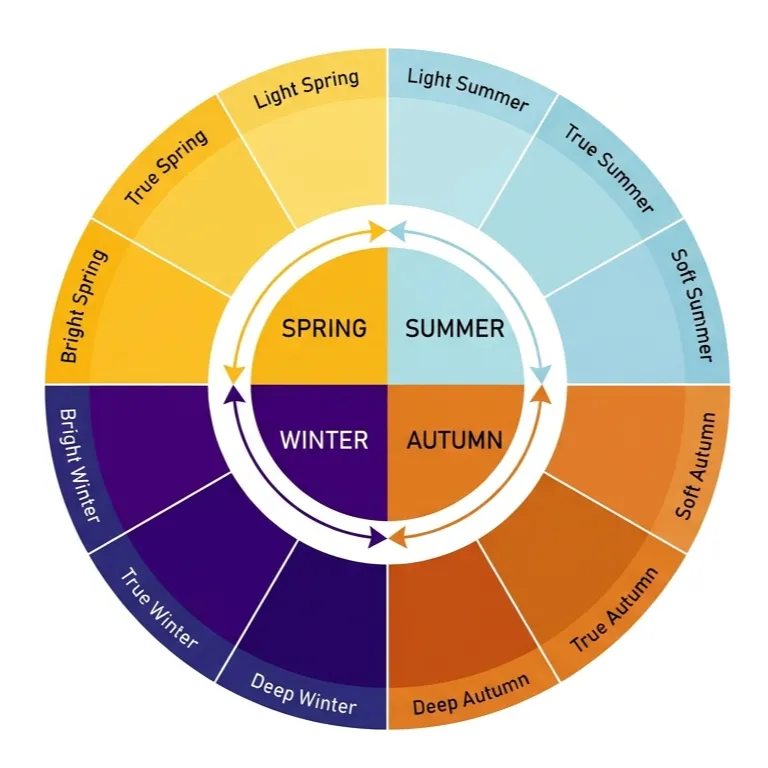
The Season Wheel: How All Twelve Connect
The twelve seasons are not isolated boxes. They sit on a continuous wheel, arranged so that neighboring seasons share the most in common. At every border between two families, there is a sub-season from each side that bridges them, which is exactly why people near those borders can often wear colors from both adjacent palettes without anything looking wrong.
Reading the wheel clockwise: Clear Winter connects to Clear Spring, Clear Spring connects to Warm Spring, Warm Spring connects to Light Spring, Light Spring connects to Light Summer, and so on all the way around. The two seasons at any border share a dimension. Clear Winter and Clear Spring both have clarity as their dominant. Light Spring and Light Summer both have lightness as their dominant. That shared dimension is what makes crossover possible.
✦ marks the true (quintessential) season within each family
🌸
The Spring Family
Three expressions of warm and light coloring
All three Spring sub-seasons share a warm undertone and do best in golden, peachy, coral, and warm ivory tones. Cool, grey-based colors drain them. What separates the three is the degree of clarity versus lightness, and how much chroma their coloring can carry before it becomes too much.
Also called Bright Spring
Dominant: Clear
Secondary: Warm
Borders: Winter
Clear Spring sits at the border between Spring and Winter. The warmth is present and real, but the most defining quality is clarity. Eyes are the standout feature, bright, sharp, and often with a visible sparkle. The complexion is clean and fresh rather than golden or peachy. This is the sub-season that most often ends up in the wrong season initially, because the Winter-like clarity can send it in a cool direction that ultimately does not fit.
Skin
Light to medium with neutral-warm undertones. A peaches and cream quality. Looks clear and fresh rather than deeply golden.
Hair
Light to medium golden, honey, or warm brown with a clarity to it, no muddiness, no ashy quality. Bright highlights are common.
Eyes
The standout feature. Bright, clear, sparkling. Bright blue, clear green, or golden hazel. High contrast between iris and white.
What works best: Warm, vivid, and clear colors. Bright coral, clear warm turquoise, golden yellow, warm ivory, light peach. Can handle more saturation than other Springs. Muddy, dusty, or grey-based tones fall immediately flat.
Clear Coral
Golden Yellow
Warm Turquoise
Warm Ivory
Warm Orange
Full Clear Spring Guide →
Dominant: Warm
Secondary: Clear
This is the quintessential Spring, warm in every feature, with no ambiguity about undertone and no borrowed quality from neighboring seasons. Skin, hair, and eyes all read unmistakably warm. The gold versus silver question is not a close call here: gold is clearly better, and wearing silver reads as noticeably off. Warm Springs are often the easiest to identify of all twelve sub-seasons precisely because their coloring is so consistent in one direction.
Skin
Obviously golden, peachy, or honey. Fair to medium. Freckles are common. Comes alive next to gold jewelry and warm ivory.
Hair
Strawberry blonde, copper, golden brown, or warm honey. Red and gold highlights are natural, not enhanced.
Eyes
Warm and clear. Golden hazel, warm green, bright turquoise, or amber. Gold and copper flecks are common.
What works best: Clear, warm, and moderately bright colors. Peach, warm coral, golden yellow, warm camel, turquoise with warmth, and soft warm green. Anything with grey or blue undertones immediately drains the complexion.
Warm Peach
Sandy Brown
Warm Mint
Cream Ivory
Golden Rod
Full Warm Spring Guide →
Dominant: Light
Secondary: Warm
Borders: Summer
Light Spring sits at the border between Spring and Summer and is one of the most commonly misidentified sub-seasons. Both Light Spring and Light Summer are pale and soft, with delicate coloring and low contrast. The difference shows up in warm versus cool colors: on a Light Spring, warm peach and soft golden tones look natural and right, while on a Light Summer they look slightly overdone. The warmth is real but it sits gently. Saturation needs to stay low, vivid or deeply saturated colors overwhelm immediately.
Skin
Light for their ethnicity. Neutral-warm undertones. Peaches and cream quality. Neither deeply golden nor clearly pink.
Hair
Light and warm. Flaxen blonde, light golden brown, or strawberry blonde. Never gets very dark naturally.
Eyes
Light and gentle. Soft blue, light green, or light hazel. Low contrast with the overall face.
What works best: Light, warm, and delicate. Soft peach, blush, warm pinks, light golden yellow, cream, and warm white. Both gold and silver work, with gold having a slight edge. Dark or saturated colors overwhelm; anything with a cool grey base falls flat.
Soft Peach
Warm Blush
Lemon Cream
Soft Mint
Warm Ivory
Full Light Spring Guide →
🌊
The Summer Family
Three expressions of cool and soft coloring
All three Summer sub-seasons share a cool undertone and do best in soft, cool, and muted tones like rose, dusty blue, cool lavender, soft grey, and cool berry. Warm, golden, or yellow-based colors drain them. What separates the three is how much softness and how much coolness is present, and whether the overall quality reads as airy, refined, or smoky.
The lightest of all twelve seasons
Dominant: Light
Secondary: Cool
Borders: Spring
Light Summer sits at the border with Spring and is the lightest of all twelve seasons. The overall appearance is airy, ethereal, and delicate. Everything reads as gentle and fair. The cool undertone is present but not dramatic, which is why this sub-season is so consistently confused with Light Spring. The distinction is in warm tones: on a Light Summer, they look slightly forced. On a Light Spring, they look natural. Cool, powder tones are where Light Summer truly shines.
Skin
Light for their ethnicity, ranging from fair to light rosy. Neutral-cool undertones with subtle pinkish tinge.
Hair
Light and cool. Ash blonde, flaxen, or light cool brown. No warmth, no golden quality.
Eyes
Light and cool. Soft blue, grey-blue, or light grey. Gentle rather than sharp or vivid.
What works best: Light, cool, and soft. Powder blue, soft rose, pale lavender, cool ivory, and dusty pinks. Silver and rose gold both work well. Warm or vivid colors look overdone; deep or saturated colors overwhelm.
Powder Blue
Soft Rose
Pale Lavender
Cool Ivory
Full Light Summer Guide →
Dominant: Cool
Secondary: Soft
This is the quintessential Summer, cool in every feature, calm in overall impression, and unmistakably refined. Skin has clearly cool or rosy undertones, hair is ashy with zero warmth, and eyes are soft and grey-toned. Silver is the obvious metal choice. Cool Summers are often described as having a polished, composed quality to their appearance, nothing is excessive or out of place. Warm tones are immediately unflattering, bringing out redness and making the complexion look dull.
Skin
Obviously cool undertones. Pink, rosy, or cool beige. Fair to medium. Silver looks crisp and fresh against it.
Hair
Cool and ashy. Ash brown, mousy brown, or cool dark blonde. Absolutely no warmth or golden quality.
Eyes
Cool and soft. Grey-blue, soft grey, or cool green. Blended rather than sharp.
What works best: Cool and muted. Soft rose, dusty mauve, cool grey, muted blue, lavender, and cool burgundy. Warm or bright colors immediately clash. Silver is the metal.
Dusty Mauve
Cool Slate
Muted Blue
Cool Burgundy
Full Cool Summer Guide →
The most muted of all twelve seasons
Dominant: Soft
Secondary: Cool
Borders: Autumn
Soft Summer sits at the border between Summer and Autumn and is the most muted of all twelve seasons. Everything about the appearance blends: features harmonize rather than contrast, nothing competes for attention, and the overall impression is smoky and quiet. The cool undertone is real but gentle, and the softness is so prominent that Soft Summers are frequently misidentified as Soft Autumns. The difference is in which muted tones work: on a Soft Summer, cool-based dusty colors look right, while warm-based earthy tones, though also muted, bring out an ashy or off quality.
Skin
Neutral to neutral-cool. May have ashy undertones with a rosy tinge. Ranges from fair to medium to cool cocoa. Skin blends with other features.
Hair
Soft and ashy. Soft brown, taupe, or mousy brown. No warmth. Often darkens or lightens without dramatic effect.
Eyes
Soft and blended. Grey-green, soft hazel, or grey-blue with flecks. Low contrast with face and hair.
What works best: Muted and dusty throughout. Dusty rose, smoky mauve, soft taupe, grey-blue, and muted cool sage. Bold or saturated colors overwhelm immediately. Can borrow from the cooler, softer end of the Soft Autumn palette.
Dusty Rose
Smoky Slate
Cool Taupe
Muted Sage
Full Soft Summer Guide →
🍂
The Autumn Family
Three expressions of warm and earthy coloring
All three Autumn sub-seasons share a warm undertone and do best in earthy, rich, and muted warm tones like terracotta, olive, rust, mustard, camel, and warm chocolate. Cool, grey-based colors clash immediately. What separates the three is the level of depth and intensity: whether softness, pure warmth, or richness and depth is the dominant quality.
Muted, earthy, and gently warm
Dominant: Soft
Secondary: Warm
Borders: Summer
Soft Autumn sits at the border between Autumn and Summer. The warmth is genuine but it does not announce itself the way it does in Warm Autumn. Everything about the coloring is muted and blended, not the copper and amber richness of a True Autumn, but earthy and quiet. This sub-season is frequently misidentified as Soft Summer because the muted quality is so prominent. The test is in how warm versus cool tones land: khaki, dusty terracotta, and camel all look effortlessly right on a Soft Autumn. Cool grey-based tones bring an ashy quality that does not suit.
Skin
Neutral, olive, or warm. Fair to tan with a golden yellow undertone. Features blend harmoniously rather than contrasting.
Hair
Soft and warm. Soft brown, warm taupe, or warm mousy brown. Not vibrant or coppery. A quiet warmth rather than a vivid one.
Eyes
Soft and warm. Soft hazel, grey-green with gold flecks, or warm brown. Blended and gentle.
What works best: Muted and warm. Khaki, dusty terracotta, warm taupe, sage, camel, and soft olive. Can borrow from the warmest, softest end of the Soft Summer palette. Vivid or clearly cool colors do not work.
Warm Khaki
Dusty Terracotta
Soft Olive
Camel
Full Soft Autumn Guide →
Dominant: Warm
Secondary: Deep
This is the quintessential Autumn, richly warm in every dimension. Skin ranges from golden to tawny to warm chestnut, hair runs copper, auburn, or deep warm brown, and eyes are amber, warm hazel, or golden brown. The gold versus silver question is never a close call. Warm Autumns are the season most associated with copper, and they often tan easily with a natural golden quality. Cool colors look visibly jarring, even muted cool tones read as off in a way that is immediately obvious.
Skin
Obviously warm. Golden, honey, warm olive, tawny, warm chestnut, or warm ebony. Freckles are common. Gold jewelry looks stunning.
Hair
Warm and rich. Copper, auburn, golden brown, or chestnut. The warmth is vivid, not subtle.
Eyes
Warm and deep. Amber, golden brown, or olive green with gold flecks. Warm and rich in quality.
What works best: Rich, warm, and earthy. Burnt orange, terracotta, mustard, warm olive, chocolate brown, deep teal with warmth, and camel. Deep, warm, and somewhat muted. Anything cool or clearly grey-based looks wrong immediately.
Burnt Orange
Mustard
Warm Olive
Chocolate
Full Warm Autumn Guide →
Dominant: Deep
Secondary: Warm
Borders: Winter
Deep Autumn sits at the border between Autumn and Winter. Features are deep and rich, dark hair with warm undertones, deep eyes, and medium to deep skin with a golden or bronze quality. The warmth is clearly present but the depth is what registers first. Deep Autumns can sometimes borrow from the warmer end of the Deep Winter palette, but cool colors always read as slightly wrong even when the tone is dark. Gold jewelry is unmistakably better. Pale or washed-out colors look immediately wrong, the depth needs depth in return.
Skin
Medium to deep with obviously warm undertones. Bronze or golden glow. May have freckles. Pairs beautifully with rich, earthy tones.
Hair
Deep and warm. Dark brown with warm undertones, chocolate, chestnut, or warm black.
Eyes
Deep and warm. Dark brown, warm black-brown, or deep amber. Rich and deep.
What works best: Deep, warm, and rich. Deep rust, chocolate, warm plum, forest green with warmth, burgundy with orange undertone, and camel. Colors need enough depth to match the intensity of the features. Anything pale or cool reads as washed out.
Deep Rust
Forest Green
Warm Burgundy
Dark Chocolate
Full Deep Autumn Guide →
❄️
The Winter Family
Three expressions of cool and striking coloring
All three Winter sub-seasons share a cool undertone and do best in cool, clear, and high-contrast combinations like pure white, icy tones, cool jewel colors, and true black. Warm, yellow-based colors look visibly wrong. What separates the three is whether depth, cool purity, or clarity is the dominant quality, and how much saturation and brightness they can carry.
Dominant: Deep
Secondary: Cool
Borders: Autumn
Deep Winter sits at the border between Winter and Autumn. Features are deep and dramatic, dark hair, deep eyes, and skin that creates high contrast with overall coloring. The coolness is definitively present, but the weight and depth of the appearance is what registers first. Deep Winters occasionally find that a few richer, deeper warm tones from the Deep Autumn palette also work for them, as the border quality means the palettes share some of the same depth. Silver is the better metal, but the gap is not always as stark as in Cool Winter.
Skin
Olive, neutral, or neutral-cool. Ranges from cool ivory to cool ebony. High contrast between skin and hair is characteristic.
Hair
Deep and cool. Dark brown, espresso, or black with cool undertones. No warmth or reddish quality.
Eyes
Deep and cool. Dark brown, cool black-brown, or deep cool hazel. Rich and deep.
What works best: Deep and cool jewel tones. Dark burgundy, forest green with cool undertone, deep teal, midnight navy, and cool chocolate. Colors need depth to match the intensity of the features. Pale or washed-out tones disappear; warm tones look slightly off.
Deep Plum
Midnight Navy
Cool Teal
Dark Burgundy
Full Deep Winter Guide →
Dominant: Cool
Secondary: Clear
This is the quintessential Winter, cool and striking in every dimension. Features are clearly cool and often sit in high contrast with each other: deep or clearly cool hair against a cool complexion, eyes that are either piercing and light or deep and rich. Silver is the obvious metal and wearing gold looks noticeably wrong. Cool Winter can wear true black and pure white more effortlessly than any other sub-season. Warm tones, golden yellows, or earthy colors immediately clash with the cool clarity of the overall appearance.
Skin
Clearly cool. Blue, pink, or red undertones depending on depth. Fair to deep. High contrast between skin and hair.
Hair
Cool and often dark. Jet black, cool dark brown, or silver-white. Absolutely no warmth.
Eyes
Clear and cool. Icy blue, piercing grey, or deep cool brown. Sharp rather than soft.
What works best: Cool, clear, and striking. True black, pure white, icy blue, fuchsia, cool red, and clear cool jewel tones. High contrast combinations are natural territory. Anything warm, earthy, or muted looks out of place.
True Black
Fuchsia
Icy Blue
Cool Red
Full Cool Winter Guide →
Also called Bright Winter
Dominant: Clear
Secondary: Cool
Borders: Spring
Clear Winter sits at the border between Winter and Spring. The coolness is definitively present, but the most striking quality is sharpness and vibrancy, eyes that are particularly vivid, a complexion with a luminous quality, and an overall brightness that separates this sub-season from the heavier drama of Cool Winter. Clear Winters can borrow from the coolest, most vivid end of the Clear Spring palette when those colors have enough clarity. The palette is vivid and clean: clear fuchsia, icy pink, bright cobalt, and pure white. Muted or dusty colors go flat immediately.
Skin
Clear, cool undertones. Fair to deep. High contrast and a radiant, luminous quality to the complexion.
Hair
Clear and cool. Jet black, cool dark brown, or platinum ash blonde. The clarity matters more than the specific shade.
Eyes
The standout feature. Brilliantly clear blue, piercing green, or sparkling dark brown. A sparkle quality is very characteristic.
What works best: Vivid, clear, and cool. Icy pink, clear fuchsia, bright cobalt, cool emerald, pure white, and true black. Colors need clarity and vibrancy to match the sharpness of the features. Muted or dusty tones go flat on skin immediately.
Icy Pink
Cobalt Blue
Cool Emerald
Clear Fuchsia
Full Clear Winter Guide →
🧪
How to Find Your Sub-Season
If you already know your main season from the four seasons guide, most of the work is already done. You are looking for one more layer of precision within the family you already belong to.
1
Ask what is most obvious about your coloring
Within your season family, what stands out most? Is it the temperature (very clearly warm or cool), the overall value (very clearly light or deep), or the clarity versus muted quality? That is your dominant characteristic and it immediately points you toward one of the three sub-seasons in your family. Use the descriptions and feature breakdowns above to compare.
2
Notice which season border feels familiar
If you have always felt that some colors from a neighboring season also work for you, that is not a contradiction. It is information. A Summer who can borrow from Autumn is likely a Soft Summer. A Winter who can wear some of the cleaner Spring colors is likely a Clear Winter. A Spring who finds that some vivid Winter-palette colors also suit is likely a Clear Spring. Crossover is a map, not a mistake.
3
Test specific colors from each candidate palette
The most reliable confirmation comes from testing. If you have narrowed it down to two sub-seasons, drape or hold colors from each palette near your face in natural light and observe how your skin reacts. The palette where your skin looks clearer, shadows soften, and redness calms is the right one. Read more about how draping works in the undertone guide.
4
Pay attention to the most confused pairs
The sub-seasons most often confused with each other are: Light Spring versus Light Summer (both pale and delicate, separated by warm versus cool tones), Soft Summer versus Soft Autumn (both muted, separated by whether cool or warm muted tones work), and Deep Autumn versus Deep Winter (both deep and rich, separated by undertone). In every case the answer is in how the skin reacts to warm versus cool test colors.
⚠️
On chasing over-precision
The 12 seasons system is more precise than four seasons, but precision is only useful if it is accurate. Getting the right main season and a nearby sub-season will serve you better than landing on a specific sub-season for the wrong reasons. If the result still feels off, revisit undertone and chroma before going further into sub-season distinctions. The foundations need to be solid first.
🤖
Not sure which sub-season fits?
Our free AI tool analyzes your photo and identifies your undertone, chroma, and most likely season in minutes. A solid starting point for narrowing down your sub-season before reading the detailed guides.
Try the Free AI Tool →
❓
Frequently Asked Questions About the 12 Seasons
What is the difference between the 4 seasons and 12 seasons system?
↓
The
four seasons system uses two dimensions: hue (warm or cool) and value (light or deep), to place you in one of four broad categories. The 12 seasons system adds a third dimension,
chroma, which captures whether your coloring is clear and vivid or muted and blended. Each main season splits into three sub-seasons, producing twelve palettes precise enough to explain why two people in the same main season can look completely different in the same colors.
Do I need the 12 seasons system to use color analysis?
↓
No. Getting your main season right already delivers most of the value. The 12 seasons system is for people who have found their main season but notice that some colors within their palette consistently work better than others, and want to understand why. It is a refinement, not a replacement for the four seasons foundation. If you have not yet found your main season, start with the
four seasons guide first.
What does dominant and secondary characteristic mean?
↓
Every person has a dominant characteristic, the most obvious quality of their coloring, and a secondary characteristic, which is the next most prominent dimension. The dominant determines which season family you belong to. The secondary determines which of the three sub-seasons within that family fits you. For example, if your dominant is warmth and your secondary is softness or muted chroma, you are likely a
Soft Autumn. If your dominant is warmth and your secondary is depth, you are likely a
Warm Autumn.
Can I borrow colors from a neighboring season?
↓
Yes, and for border sub-seasons this is expected rather than exceptional. Soft Summer can borrow from the warmest, softest end of
Soft Autumn.
Light Spring can borrow from the warmest end of
Light Summer.
Clear Winter can borrow from the coolest, most vivid end of
Clear Spring. The fact that crossover works is not a sign of misidentification, it is how the system is designed.
What is the most muted season?
↓
Soft Summer is generally considered the most muted of all twelve seasons. Its coloring is blended and smoky throughout, and it does best in the dustiest, most muted colors available. Saturated or bold colors overwhelm it more readily than any other season.
What is the most vivid season?
↓
Cool Winter and
Clear Winter carry the most vivid and saturated palettes. Both can handle pure black and white, true jewel tones, and high contrast combinations that would overwhelm other seasons. Clear Winter specifically is defined by its clarity and brightness, it is the sub-season most associated with the sparkle and vivid quality of its coloring.
Is professional analysis necessary to find my sub-season?
↓
Not necessarily, but it is the most reliable path when self-analysis feels inconclusive. Sub-season distinctions can be subtle, particularly at borders like
Soft Summer versus
Soft Autumn, or
Light Spring versus
Light Summer, and a trained analyst observing skin reactions during draping will resolve those subtle distinctions more accurately than any self-assessment. If you have narrowed it down and still cannot determine the difference,
professional analysis gives you a definitive answer.