Soft Summer Overview
Value
Light to medium
Contrast
Low to medium
Undertone
Neutral-cool
Chroma
Soft
Sister season
Soft Autumn
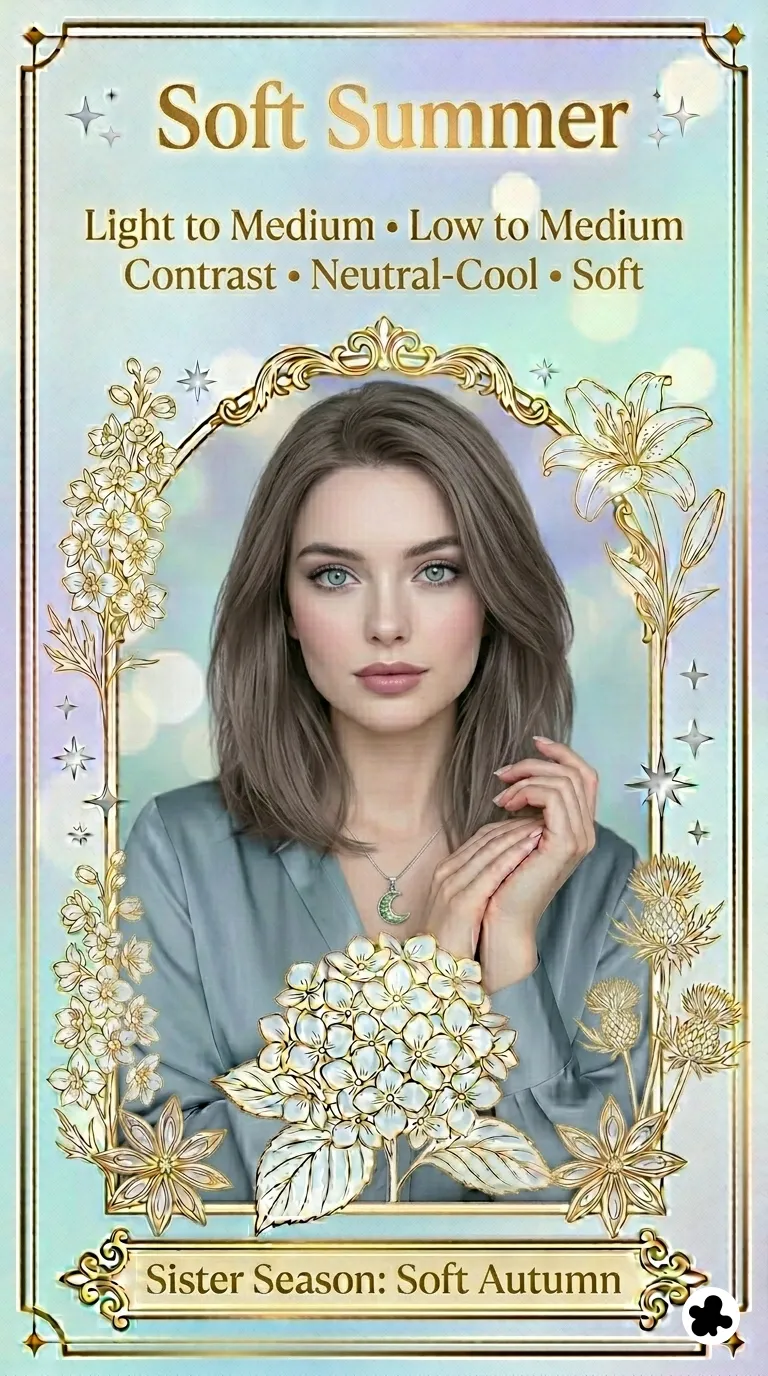
Soft Summer borders Autumn, and that border changes everything. Of the three Summer sub-seasons, Soft Summer is the one farthest from the cool freshness that defines the family at its center. The coolness is still present and still real, but it has been filtered through a softness and mutedness that belong to the neighboring season. The result is a palette that is uniquely smoky, blended, and understated.
The dominant characteristic is softness in chroma. Before anything else, Soft Summer coloring reads as muted and blended. The secondary characteristic is coolness, which keeps the palette on the cool side of neutral and separates it from its Autumn neighbor. Together they produce a season that is the softest expression of what Summer can be.
The border with Soft Autumn is the source of the most difficult identification challenge this season faces. Both are muted. Both have low contrast. Both have features that blend together rather than contrast with each other. The single dimension that separates them is temperature, and it is visible in draping even when it is nearly impossible to read from features alone. Read the 12 seasons guide before going further if you want to understand the full system.
Soft Summer
Summer family · Borders Autumn
Secondary
Neutral Cool (Temperature)
Metals
Matte silver, rose gold
Why Soft Summer is one of the hardest seasons to identify
Most seasons have at least one feature that reads clearly: a cool pink undertone, an obviously warm glow, a high contrast between dark hair and light skin. Soft Summer often has none of these. Skin is neutral, hair is medium and ashy, eyes are soft and blended. Nothing announces itself. The identification challenge is that Soft Summer reads as ordinary or nondescript in its natural state rather than clearly belonging to one family or another. Draping, not feature analysis, is the most reliable path to identification for this season. The colors that make Soft Summer coloring come to life are specific enough that seeing the difference in a fabric comparison settles the question when feature analysis alone does not.
🌿
Soft Summer Coloring: What to Look For
The overall impression of Soft Summer coloring is blended, harmonious, and soft. Skin, hair, and eyes read as similar in depth and do not contrast sharply with each other. There is no single feature that stands out. When you look at someone who is a Soft Summer, the first word that comes to mind is usually understated or serene rather than striking, warm, or glowing. The beauty is quiet and requires looking rather than announcing itself immediately.
🧴
Skin
Soft Summer skin is the most complex of the Summer family to describe because it is the least obviously cool. The undertone is neutral-cool rather than distinctly pink or rosy. This is not the clearly pink porcelain of Cool Summer. It can read as beige, soft taupe, or cool tan, and in some cases has a slightly greyish or ashy quality. The range extends further toward medium and medium-deep than the other Summer sub-seasons, partly because the softened chroma of the season allows for deeper coloring while maintaining the muted overall impression. Freckles, where present, are soft and ashy in tone, never golden or warm.
Light neutral beige
Soft cool taupe
Medium ashy beige
Cool medium tan
The neutral-cool quality of Soft Summer skin is easiest to confirm through draping. Yellow gold fabric will pull a slightly sallow or greenish quality out of the skin that silver fabric does not. The difference may be subtle compared to a more obviously cool season, but it is consistently present.
💇
Hair
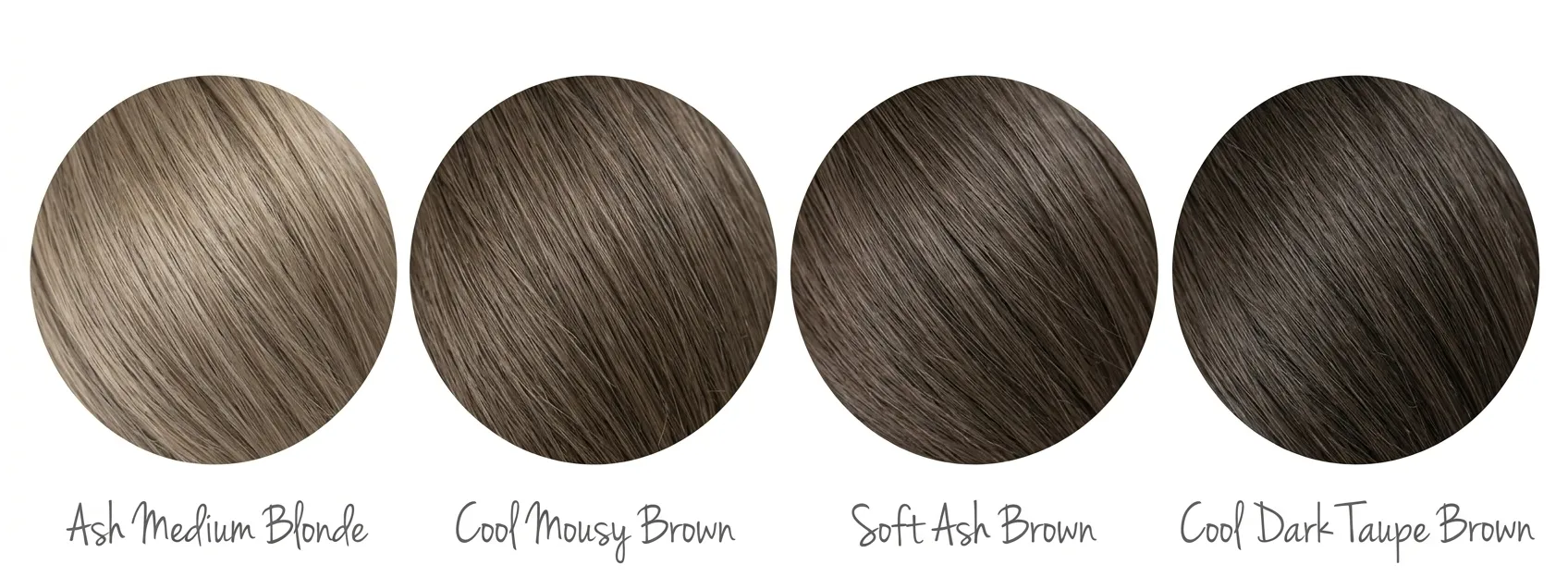
Soft Summer hair is consistently described as mousy, ashy, or taupe. It is medium in depth and cool in temperature, but neither quality is pronounced enough to be immediately obvious. There are no golden or reddish highlights. The hair lacks the vibrancy of a warm-toned brunette and the airiness of an ash blonde. It occupies a quiet middle ground that blends harmoniously with the skin rather than contrasting against it. Many Soft Summers feel their hair color is one of the most unremarkable things about them, which is actually one of the season's most characteristic features. Greys that come in over time tend to be a soft ash or silver, which is one of the most flattering greying patterns of any season.
Soft ash blonde
Mousy cool brown
Cool taupe brown
Soft cool espresso
👁️
Eyes
Soft Summer eyes are characteristically blended. They do not read as a clear, defined color. Blues have grey in them. Greens have grey and brown in them. Hazels have a soft, smoky quality that makes the color difficult to define precisely, mixing grey, green, and a muted warm-neutral brown that is never golden. Even the irises seem to blend into the whites of the eyes rather than standing out sharply. People with Soft Summer eyes are sometimes described as having changeable eyes because the eye color shifts visibly depending on what they are wearing, which is a direct consequence of the low chroma of the iris. High-chroma colors make the eyes look flat; the season's own muted palette makes them look deeper and more complex.
Smoky blue-grey
Soft grey-green
Smoky hazel
Muted cool brown
The changeable nature of Soft Summer eyes is a useful identification signal. If your eyes seem to look completely different depending on what you wear, and if muted, blended tones consistently make them look richer while bright or warm tones make them look flat, this is characteristic Soft Summer behavior.
🎨
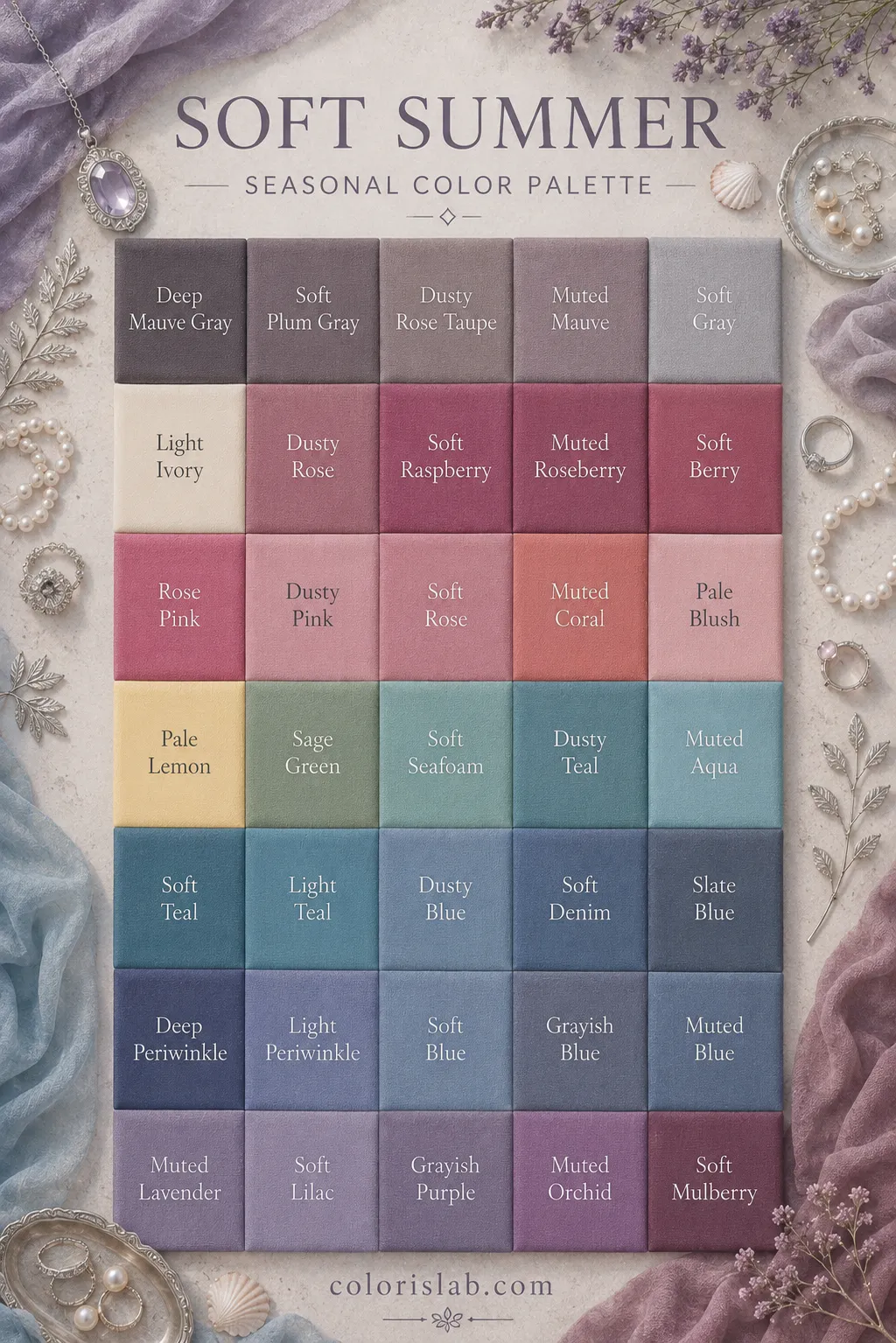
The Soft Summer Color Palette
Soft Summer colors share one quality above all others: they are greyed down. Every color in the palette has been softened with grey or smoke, reducing its saturation and creating a blended, diffused quality. Think of colors seen through mist or reflected in still water on an overcast day. They are cool in temperature, never warm, but the coolness is not sharp or defined. It is soft and quiet.
This is the lowest-chroma palette in the Summer family. It is more muted than Cool Summer, more muted than Light Summer, and sits closer to the Soft Autumn palette than any other Summer sub-season does to any Autumn sub-season. The coolness is what keeps it in Summer; the softness is what makes it unique.
✓ Colors that work
Dusty rose
Muted mauve
Smoky blue-grey
Soft sage green
Grey-green
Greyed lavender
Soft raspberry
Greige
Soft grey
Muted soft navy
Cool mushroom
Rose-brown
✗ Colors that don't work
True black
Stark white
Warm peach
Coral
Warm olive
Mustard
Rust
Any bright clear color
Icy stark pastels
Electric blue
Vivid fuchsia
Golden yellow
Colors fail on Soft Summer in three distinct ways. Warm colors introduce a temperature that conflicts immediately with the cool undertone, producing sallowness. Bright or vivid colors overpower the low chroma of the coloring, making the skin look washed out and the color look separate and unrelated to the person wearing it. High-contrast combinations, regardless of individual color temperature, break the natural blended quality of the coloring and create a jarring, disjointed impression. The palette is always soft, always cool, and always part of a whole rather than a single element demanding attention.
A note on borrowing from neighboring seasons
Soft Summer can borrow from both Cool Summer and Soft Autumn at the borders of its palette, but in limited ways. From Cool Summer, the most muted and least vivid tones can work. From Soft Autumn, only the coolest and most neutral tones are possible: a greyed warm taupe at the very cool edge of the Autumn palette, for example, can sometimes work on Soft Summer, but anything with obvious warmth will not. The rule is always to take the coolest tones from the warm side and the most muted tones from the brighter side.
Soft Summer is the one season where finish matters as much as metal color. Silver and rose gold are the right temperature choices, but high-polish, bright-finish versions of either can be too stark for the low chroma of this season. A brushed or matte silver suits Soft Summer coloring better than a mirror-polished version. The same applies to rose gold: a warm-toned, polished rose gold can read too vivid, while a softer, more matte version works beautifully. The goal is jewelry that blends with the skin and enhances it rather than standing sharply apart from it.
Matte silver
Brushed platinum
Soft rose gold
White gold
Pale champagne gold
Bright yellow gold
Bronze
High-polish bright silver
For gemstones, look for soft, muted, and lightly luminous: rose quartz, smoky quartz, grey pearl, lavender amethyst, moonstone, soft aquamarine, and muted soft blue topaz. The smokier and more blended the stone, the better it will suit this season. Brilliant-cut, highly reflective stones that sparkle intensely are too vivid for the low chroma of Soft Summer. Warm stones like citrine, amber, and coral are the wrong temperature entirely.
Soft Summer makeup has a different brief than other seasons. The goal is not to create a defined look or a polished finish. It is to enhance the natural blending of the coloring by using muted, cool, and harmonious pigments that feel like an extension of the features rather than a layer placed over them. Bold definition, warm tones, bright colors, and high-contrast combinations all work against this season. The best Soft Summer makeup looks as if it might not be there at all, while the skin reads as slightly more even, the eyes slightly deeper, and the lips slightly richer than in the unadorned state.
Neutral or neutral-cool undertoned formulas. Descriptors like neutral, beige, or ivory without any warm, golden, or peachy qualifier. Because Soft Summer skin is not distinctly pink the way Cool Summer skin is, formulas that are too pink can be as wrong as ones that are too warm. The aim is as close to the natural skin tone as possible in undertone. A natural or satin finish is ideal.
neutral beige
cool ivory
natural taupe
Dusty rose, muted mauve, soft rose-brown, and taupe-blush. Blush should be applied very softly and blended thoroughly. The goal is a suggestion of color rather than a defined flush. Anything too pink, too coral, or too bright will look separate from the face rather than part of it. Rose-brown and dusty mauve are the most characteristic Soft Summer blush tones.
dusty rose
muted mauve
rose-brown
Soft taupe, muted mauve, cool mushroom, and greyed lavender for everyday. A soft smoky eye using greyed plum and cool charcoal is one of the most flattering eye looks for this season, giving the eyes depth without harsh definition. Liner in cool charcoal or soft grey-brown rather than black. Jet black creates too sharp a contrast; a softer version integrates better with the low-chroma coloring.
greyed mauve
greyed plum
cool mushroom
Dusty rose, muted mauve, rose-brown, soft plum, soft berry, and muted cool red. Matte and satin finishes suit Soft Summer well, with the matte finish particularly harmonious with the low-gloss quality of the season overall. Glossy finishes can work but should be in the right tones. Avoid coral, peach, warm nude, bright pink, and anything with an obvious warm or orange undertone.
dusty rose
soft plum
muted cool red
On contouring and highlighting
Heavy contouring and bright highlighting both work against Soft Summer. Contouring products with warm, bronzy undertones introduce warmth that clashes with the cool undertone. Bright, icy highlighters create a high-contrast point that breaks the blended quality of the coloring. A soft, cool-toned contour and a very subtle luminous highlight in a muted, cool tone are possible for those who use these techniques, but the overall result should always preserve the sense of even, harmonious skin rather than sculpted definition.
⚖️
Soft Summer vs. Neighboring Seasons
Soft Summer is most commonly confused with three seasons: Soft Autumn, Cool Summer, and occasionally Light Summer. The Soft Autumn confusion is the most consequential because the two seasons share their dominant characteristic and differ only in temperature.
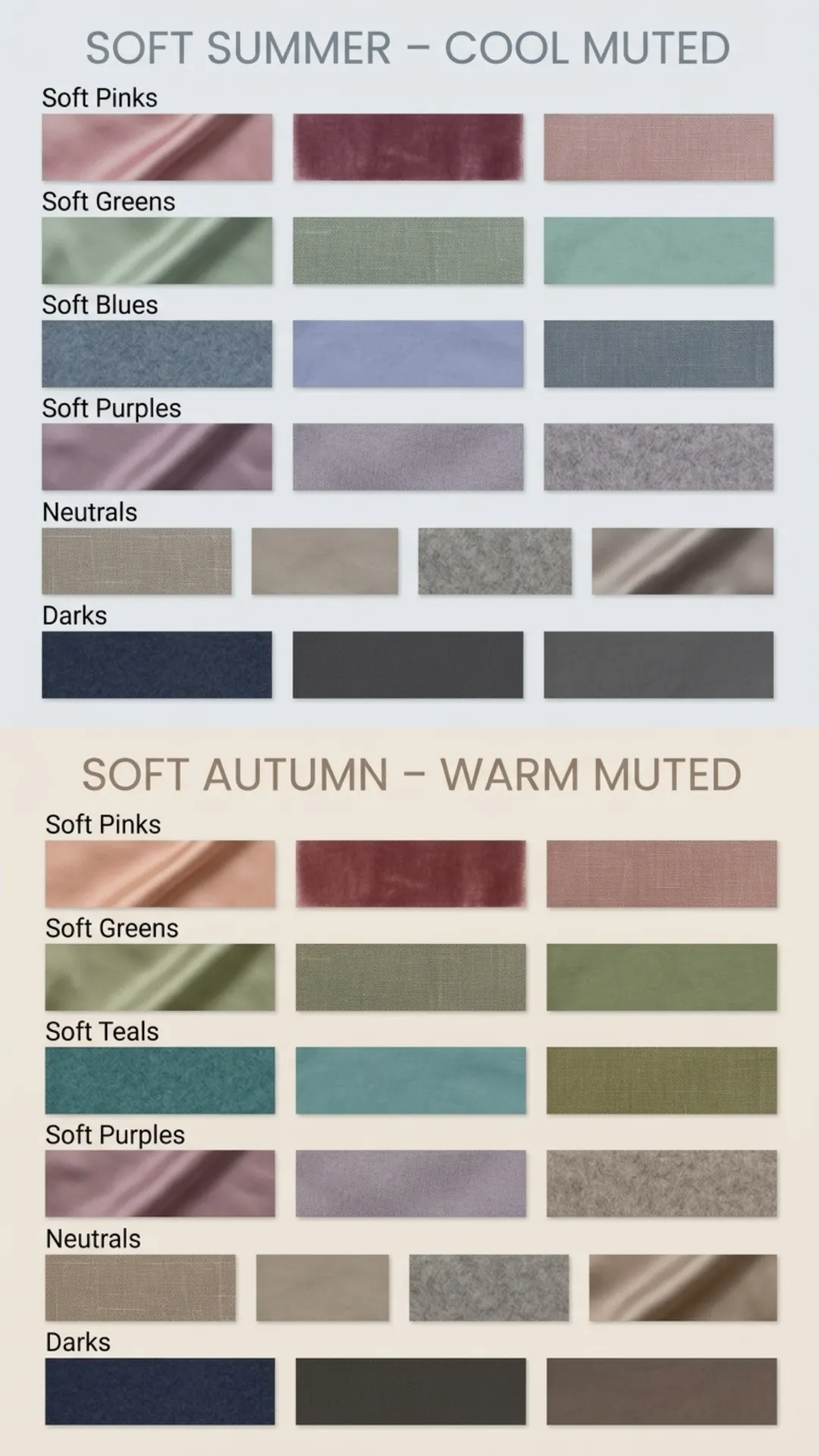
Most important distinction
Muted and cool. Silver harmonizes with the skin. Cool muted tones like dusty rose and grey-blue feel right. Warm tones, even muted ones, produce a slight sallowness or greyness in the skin. The mutedness is about cool smoke rather than warm dust.
Muted and warm. Yellow gold harmonizes with the skin. Warm muted tones like soft olive and warm taupe feel right. Cool tones, even muted ones, make the skin look slightly grey or flat. The mutedness is about warm dust rather than cool smoke.
The test: Hold a soft olive fabric (warm muted) and a soft grey-blue fabric (cool muted) up in turn. Whichever makes the skin look clearer and more alive tells you which season you are. Olive works for Soft Autumn; grey-blue works for Soft Summer. This single test, done in natural light, resolves most cases where feature analysis has been inconclusive.
Chroma dominates. Everything is greyed-down. A clear dusty rose looks slightly too defined and vivid. The palette needs to be greyed and blended throughout. High definition or saturation in any color makes the coloring look flat by comparison.
Hue dominates. The coolness is defined enough to allow medium-saturation colors without looking flat. A clear dusty rose looks grounded and right. The palette can carry more definition without overwhelming the coloring.
The test: Try a clear dusty rose and a heavily greyed, smoky mauve side by side. If the clear dusty rose looks right and polished, you lean Cool Summer. If the smoky, greyed version looks more harmonious and the clear version seems slightly too defined, you are Soft Summer.
Medium in depth with low chroma. Airy or very pale colors feel too delicate and empty. The palette needs a grounded, blended quality. Light, clear tones do not have enough substance for this season's coloring.
Light in value with gentle chroma. Grounded or medium-depth colors feel slightly heavy. The palette needs to stay airy and delicate. Dusty or smoky tones feel slightly muddy rather than harmonious.
The test: Try a very pale powder blue and a greyed dusty blue side by side. If the pale version looks fresh and the greyed version is slightly heavy, you are Light Summer. If the greyed dusty blue looks more harmonious and the pale version seems too empty, you are Soft Summer.
👗
Building a Soft Summer Wardrobe
A Soft Summer wardrobe is built around the principle of tonal harmony. Every piece should feel as if it belongs to the same world: cool, muted, and blended. The result is a wardrobe that may look understated or even plain when viewed in isolation but becomes quietly sophisticated when worn by the right person. The opposite experience, where the clothes wear the person rather than the person wearing the clothes, is what happens when Soft Summer coloring meets bright, warm, or high-contrast clothing.
Soft white and cool off-white replace stark white. Soft grey and greige replace black. Cool mushroom, taupe, and rose-brown replace warm camel or beige. Soft navy is the deepest reliable neutral in this palette, functioning where other seasons might reach for deep charcoal or black. These neutrals form the backbone of Soft Summer dressing and can carry an entire wardrobe with only minimal signature color additions.
Cool off-white
Soft grey
Cool mushroom
Muted soft navy
Dusty rose, smoky blue-grey, soft sage, greyed lavender, muted mauve, rose-brown. These colors do something visible when worn near Soft Summer coloring: the skin looks clearer, the eyes look deeper, and the overall impression becomes quietly luminous rather than flat. They do not work this way for other seasons, which is the clearest indication that the season identification is correct.
Dusty rose
Smoky blue-grey
Soft sage
Rose-brown
3
Contrast, Prints, and Texture
Soft Summer has the lowest natural contrast of the Summer sub-seasons, and outfit combinations should reflect this consistently. Tonal dressing is the approach that works best: layers of dusty rose and mauve, or smoky blue-grey with soft grey and mushroom. Any single element that stands out too sharply from the rest disrupts the blended harmony that makes Soft Summer dressing look sophisticated rather than plain. For prints, watercolor effects, soft abstract patterns, blurred florals, and subtle textures are all harmonious. Matte or soft-sheen fabrics suit this season well: cashmere, soft cotton, linen, matte silk, suede. High-shine fabrics introduce a contrast between the finish and the coloring that breaks the overall softness.
🤖
Still unsure if you're a Soft Summer?
The Soft Summer identification challenge is real. The season does not announce itself the way others do, and the border with Soft Autumn is genuinely difficult in photos. Our AI tool looks at your photo for undertone signals and gives you a starting temperature read as a first step before draping.
Try the Free AI Tool →
❓
Frequently Asked Questions
Why is Soft Summer so hard to identify?
↓
Because the season's defining characteristics are the absence of things rather than the presence of them. There is no obvious warmth to identify, no obvious coolness to identify, no high contrast, no pronounced depth, no strong chroma. Features blend together harmoniously without any single element standing out. Most identification methods, whether self-analysis by mirror or photo review, rely on identifying something notable about the coloring. Soft Summer often does not give that. Draping, where the difference between what works and what does not is visible in real time on the skin, is the method that works most reliably for this season.
Can a Soft Summer wear black?
↓
Black is the most difficult neutral for Soft Summer near the face. It creates a contrast level that does not match the natural low contrast of the coloring, and it lacks the muted, blended quality that this season needs. The skin tends to look flat or tired next to black rather than alive and clear. Soft charcoal and deep soft grey are much better alternatives for formal or dark neutral needs. In clothing away from the face, the impact is lower, but even there, very dark tonal dressing in navy or deep grey tends to produce a more harmonious result than pure black.
I have warm coloring but I test cool in draping. Can I be a Soft Summer?
↓
Yes. Soft Summer is the season most likely to produce this experience. The
skin tone and
undertone in Soft Summer are neutral-cool rather than clearly cool. The neutral element means some Soft Summers have coloring that reads as warm or neutral under casual observation. Hair that is mousy-brown can look warm in some lighting. Eyes that are hazel can read as warm. But when gold versus silver draping is done in consistent natural light near the face, the cool undertone becomes visible because the gold consistently introduces a slightly sallow or grey quality that the silver does not. Trust the draping result over the feature reading.
Does Soft Summer age well in terms of coloring?
↓
Soft Summer is one of the seasons that tends to age gracefully in terms of coloring. The natural greying pattern, where hair turns to soft silver or ash rather than yellow-white, is one of the most attractive greying patterns of any season. The muted, blended quality of the coloring means there is less obvious change as depth decreases with age than in seasons that start with stronger contrast. Many Soft Summers find that their coloring actually becomes more balanced and harmonious over time. The palette remains essentially the same throughout; the proportions within it may shift slightly toward the lighter end as the hair lightens.
What is the difference between Soft Summer and Soft Autumn undertone?
↓
Both have neutral undertones in the sense that neither is strongly warm or strongly cool at first glance. The difference is in the direction of the neutrality. Soft Summer's neutral leans cool: when pushed, the skin looks clearer next to cool tones and slightly sallow or flat next to warm ones. Soft Autumn's neutral leans warm: when pushed, the skin looks clearer and more alive next to warm tones and slightly grey or flat next to cool ones. The two seasons look similar in casual observation and different in draping. The difference does not need to be dramatic to be real; even a slight, consistent pattern in one direction over the other is the reliable indicator.