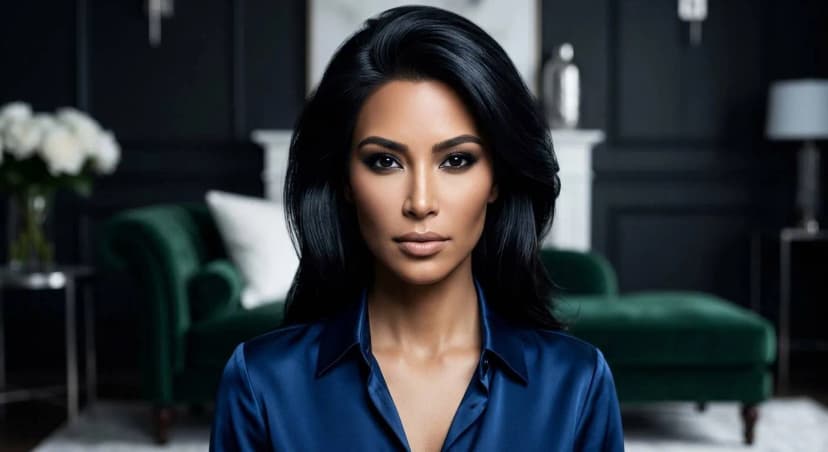
Deep Autumn Overview
Value
Deep
Contrast
High
Undertone
Neutral-warm
Chroma
Soft
Sister season
Deep Winter
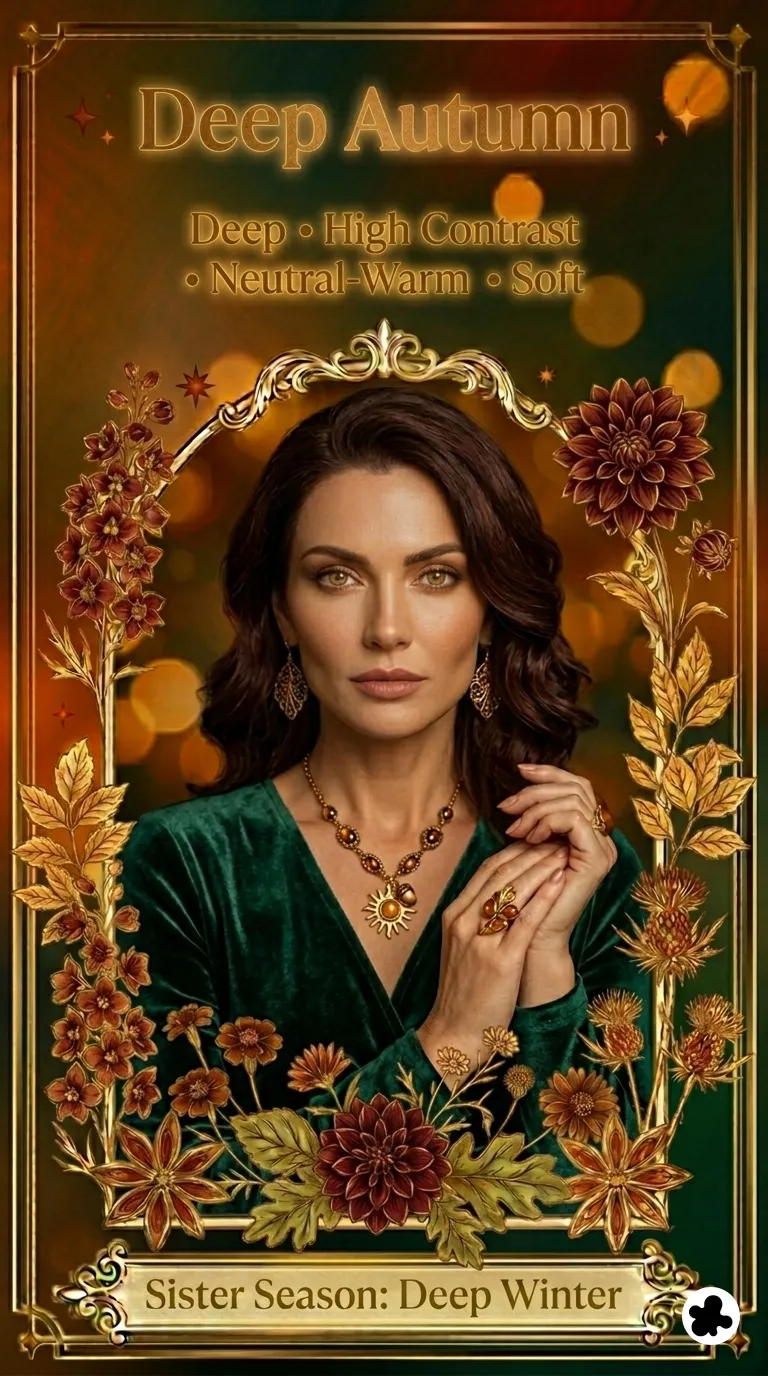
Deep Autumn or Dark Autumn is the sub-season at the furthest edge of the Autumn family from its muted center. The warmth is still present and still defining, but it has been intensified by depth until it sits right against the border of the Winter family. Of the three Autumn sub-seasons, Deep Autumn is the one closest to the cool, dramatic Winter family, and that border shapes its palette in meaningful ways.
The dominant characteristic is depth in value. Before anything else, Deep Autumn coloring reads as dark and rich. The secondary characteristic is warmth, which keeps the palette on the warm side of neutral and separates it from its nearest neighbor, Deep Winter. Together they produce the deepest palette in the entire Autumn family.
The border with Deep Winter is the most important identification challenge this season presents. Both are dark. Both have strong presence. The single dimension that separates them is temperature, which is clearly visible in draping even when features alone look ambiguous. Read the 12 seasons guide if you want to understand how border seasons work before going further.
Deep Autumn
Autumn family · Borders Winter
Metals
Gold, bronze, copper
🌿
Deep Autumn Coloring: What to Look For
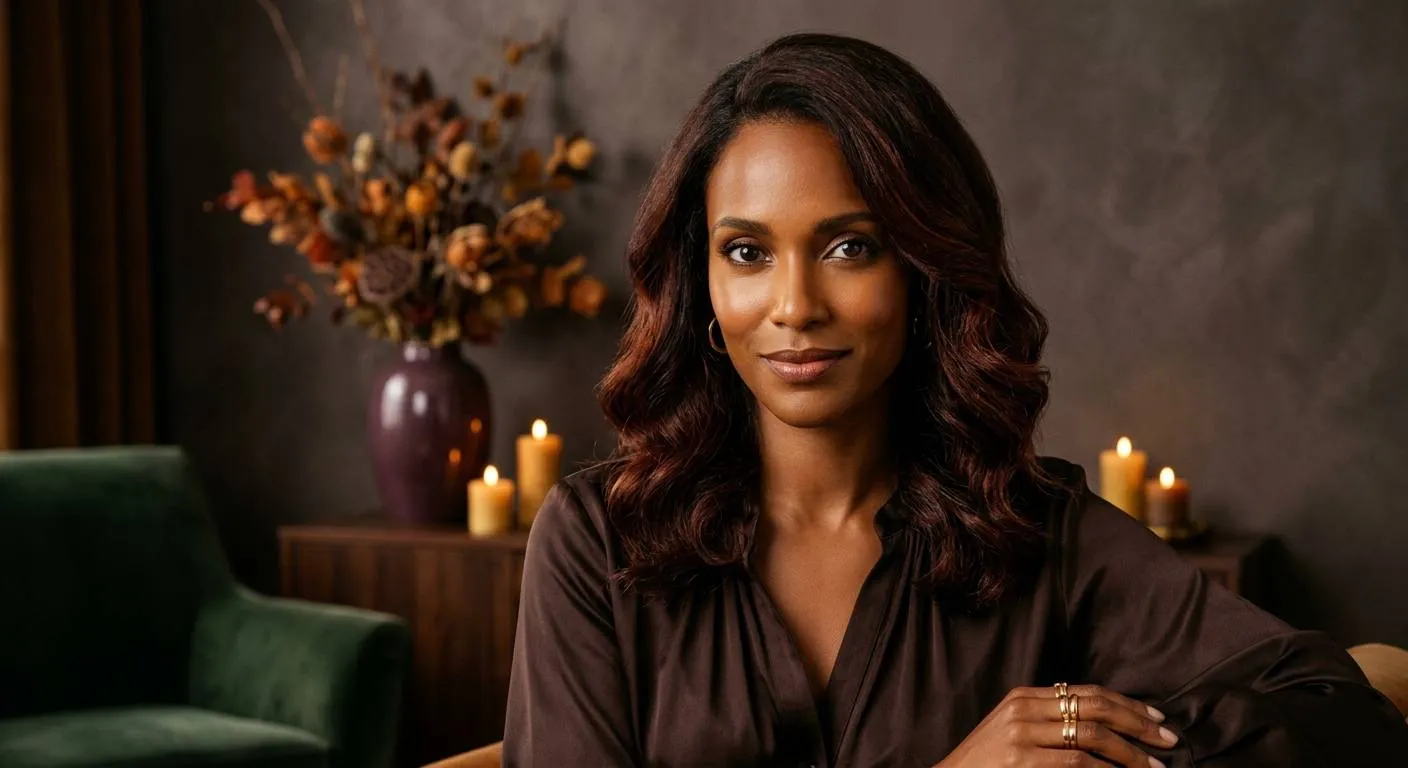
The overall impression of Deep Autumn coloring is rich, dark, and warm. Skin has obvious depth and warmth. Hair is dark and carries warmth even at its darkest. Eyes are deep and penetrating. There is medium to high contrast between features, giving the appearance a substantial, commanding quality. When you look at someone who is a Deep Autumn, the first words that come to mind are usually rich, deep, or striking. The beauty is profound and present rather than delicate or understated.
🧴
Skin
Deep Autumn skin is rich and warm, ranging from medium to deep in value. The undertone is warm, though in deeper skin tones this warmth manifests as a bronze, rich chestnut, or warm cocoa quality rather than the obvious golden or peachy quality it has in lighter Autumn seasons. The depth of the coloring can sometimes obscure the warmth on first impression, which is one of the reasons Deep Autumn is sometimes confused with the cool Deep Winter. In the sun, Deep Autumn skin tans easily and deeply, building a rich, warm glow.
Warm olive medium
Warm bronze tan
Rich chestnut deep
Deep warm ebony
💇
Hair
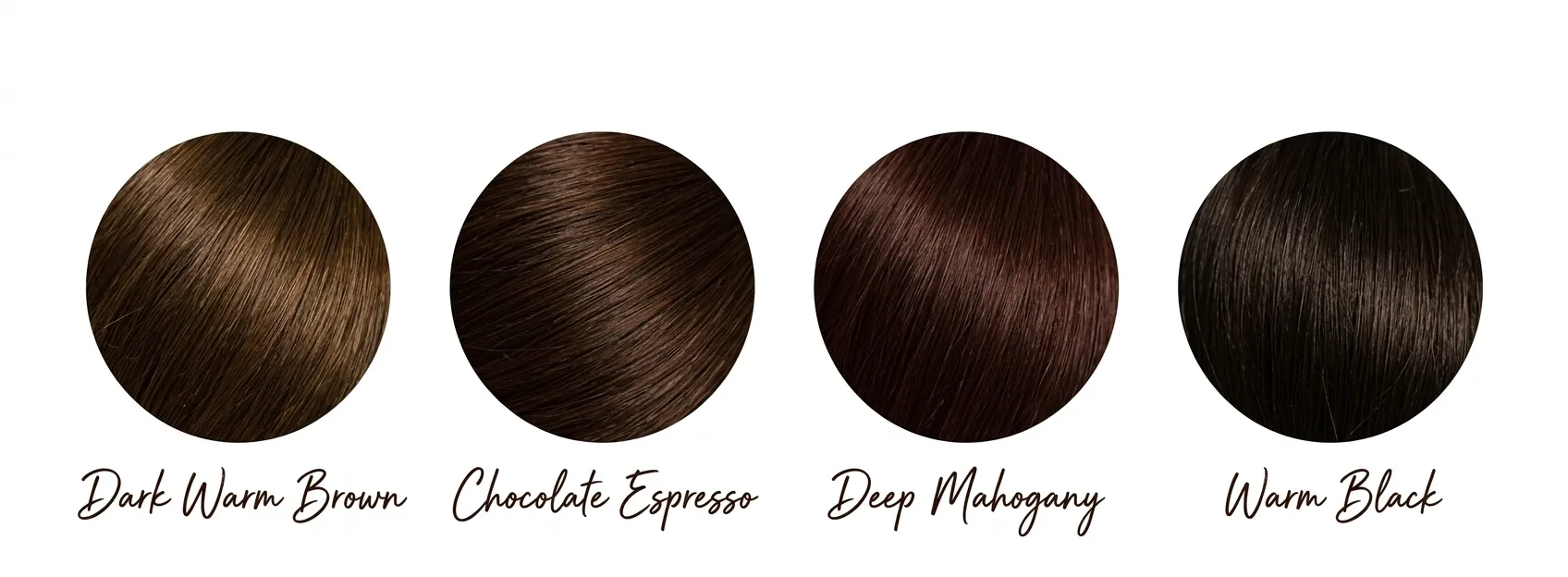
Deep Autumn hair is dark and warm. It is one of the most striking features of this season, with a richness that reads immediately as deep and warm rather than cool. Browns are chocolate, espresso, or mahogany, never ashy. Black hair, when present, carries brown or warm undertones rather than a cool blue-black quality. In sunlight, golden, copper, or warm brown glints may be visible even in very dark hair. Light blonde or ash brown hair is not characteristic of this season at its center.
Dark warm brown
Chocolate espresso
Deep mahogany
Warm black
👁️
Eyes
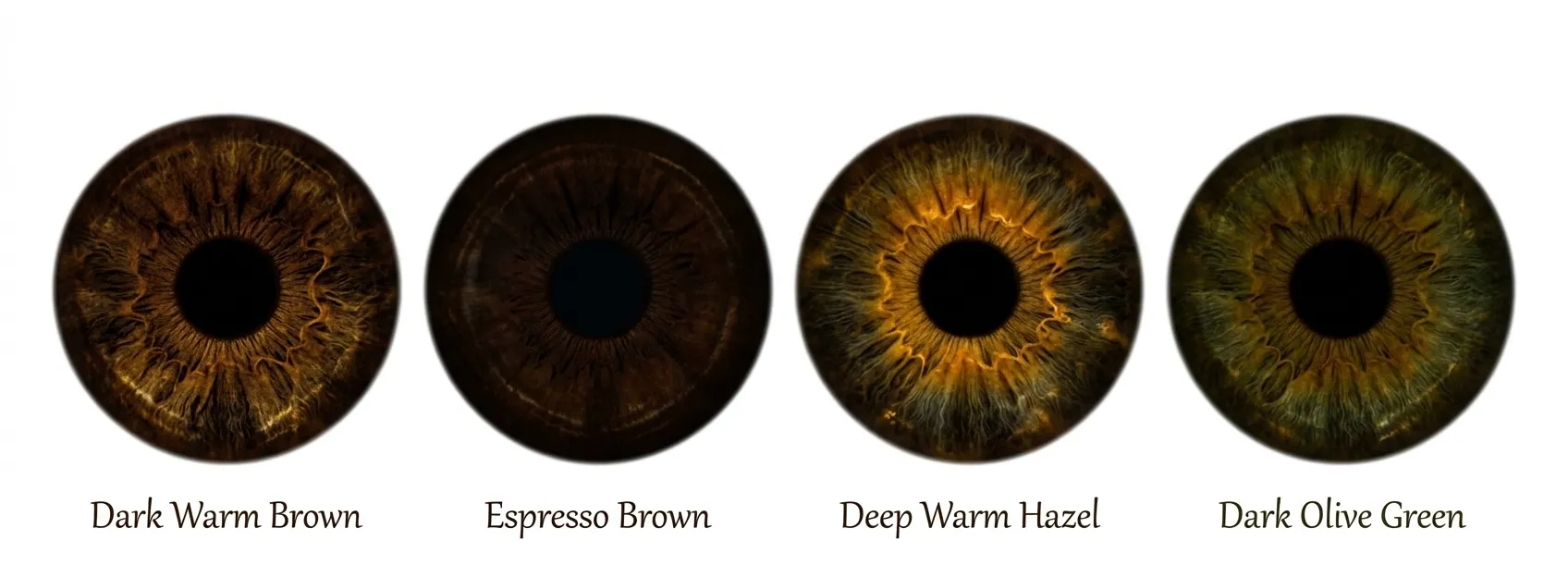
Deep Autumn eyes are dark, warm, and penetrating. They may appear almost black at first glance, but in good light the warmth and depth become visible. Browns are dark and warm with golden or amber flecks. Hazels are deep and rich, mixing dark brown with gold and sometimes deep olive or forest green. Pure green eyes are uncommon in this season, but dark olive green can appear. The eyes have a presence and intensity that is one of the most characteristic features of Deep Autumn coloring.
Dark warm brown
Espresso brown
Deep warm hazel
Dark olive green
🎨
The Deep Autumn Color Palette
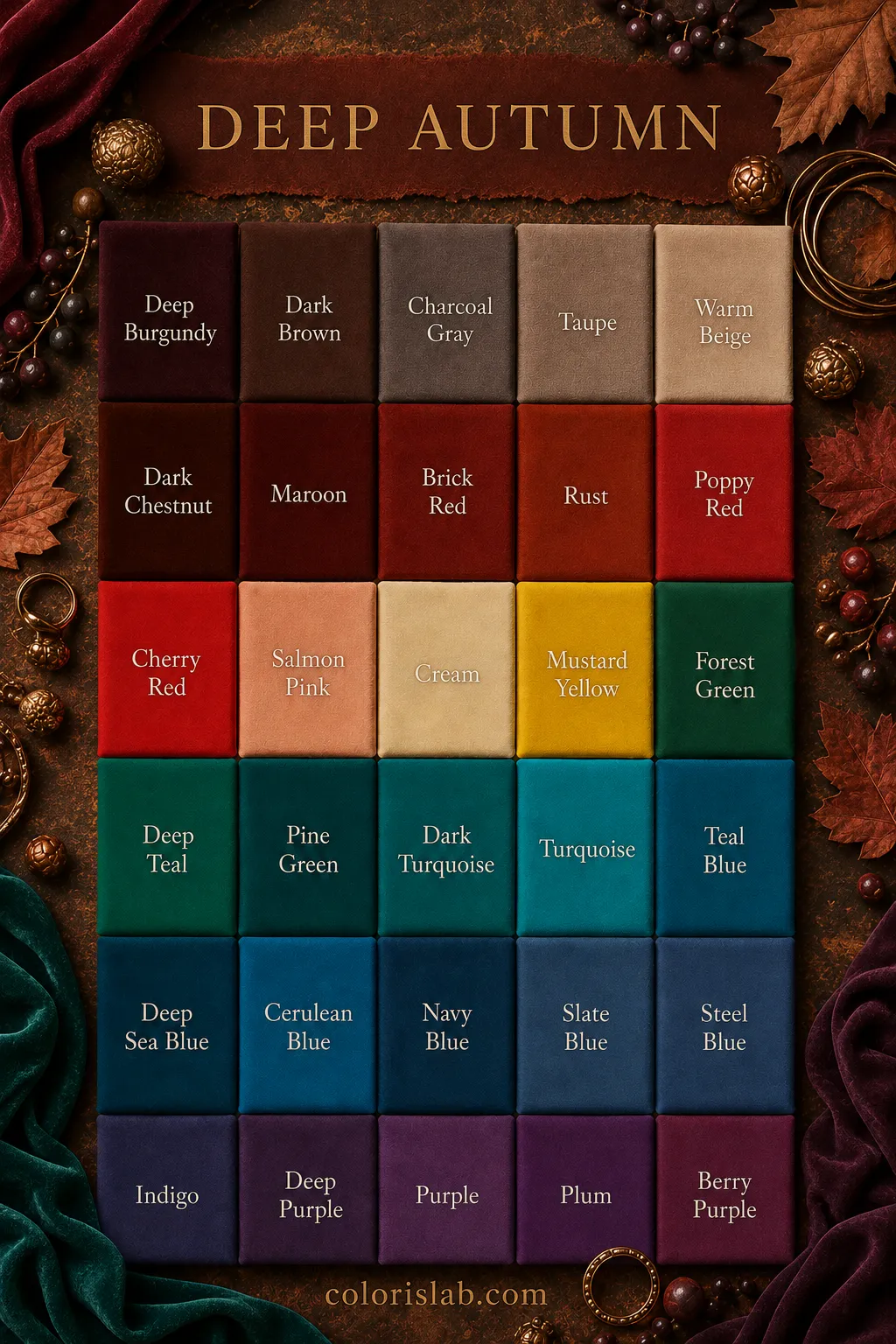
Deep Autumn colors share two qualities above all others: they are dark and warm. Every color in the palette has been deepened until it sits at the richest, most intense end of the warm range. Think of the forest at twilight, the darkest autumn leaves at peak color, the richest spices. This is the deepest palette in the Autumn family, darker than Warm Autumn and darker than Soft Autumn, and it sits closer to the Winter palette than any other Autumn sub-season.
The palette is deep in value. Very light colors are rare and when they appear, they are the warmest, most grounded light tones rather than anything airy or pale. Chroma is medium to high, which gives the palette its intensity and allows it to borrow from the Winter palette in ways the other Autumn sub-seasons cannot.
✓ Colors that work
Chocolate brown
Espresso
Deep olive
Forest green
Burgundy (warm)
Aubergine
Deep rust
Warm navy
Pumpkin
Curry
Deep terracotta
Warm teal
✗ Colors that don't work
Cool black
Pure white
Icy pastels
Light baby blue
Soft pink
Cool lavender
Silver grey
Fuchsia
Electric blue
Cool navy
Cool burgundy
Light pastels
Colors fail on Deep Autumn in three distinct ways. Cool colors conflict with the warm undertone even at depth, making the skin look grey or slightly off. Very light or pale colors lack the depth the coloring needs and create a disconnected impression, as if the clothing belongs to someone else. Colors that are deep but cool, such as cool navy or cool burgundy, fail on temperature even though they have the right value. The palette is always deep, always warm, and always commands presence.
A note on black
Unlike other Autumn sub-seasons, Deep Autumn can sometimes wear black near the face, but only the right black. The black must have warm, brown undertones rather than a cool blue-black quality. Even then, warm navy, deep chocolate brown, and dark warm olive are more naturally harmonious alternatives. If you choose to wear black, warm it with gold jewelry and warm makeup to bridge the temperature gap.
Gold is the natural metal for Deep Autumn, and the test is both immediate and decisive: silver creates a visible coolness against the skin, while gold integrates completely. Because Deep Autumn's chroma is higher than Soft Autumn and the depth of the coloring is greater, this season can carry more drama in its jewelry than other Autumn sub-seasons. Large-scale gold pieces, hammered or antiqued finishes, and richly detailed designs all work well. Bronze and copper add an earthy, organic quality that suits the season's character.
Yellow gold
Bronze
Copper
Antique gold
Silver
Platinum
Bright silver
For gemstones, deep, warm, and richly luminous options work best: garnet, dark amber, tiger's eye, deep citrine, warm topaz, peridot, moss agate, and carnelian. Darker stones like deep red jasper and warm onyx also work beautifully. Cool stones, including sapphire, amethyst, and aquamarine, are the wrong temperature. Natural materials, including leather, bone, and dark wood, resonate naturally with the season's earthy, organic depth.
Deep Autumn makeup should enhance the natural depth and warmth, creating a rich, grounded look that feels powerful rather than overdone. The palette can carry more definition and intensity than other Autumn sub-seasons because the coloring itself has more contrast to work with. Cool-toned pigments, pink-based products, and icy or silver qualities all work against this season. The best Deep Autumn makeup looks richly warm and effortlessly dramatic.
Warm, golden, or yellow undertoned formulas that match the depth of the skin. Descriptors like warm, golden, tan, honey, caramel, or bronze are reliable guides. For deeper skin tones, look for orange or warm brown correctors for under-eye darkness. Avoid anything with a pink or cool base. A satin or natural finish works best; matte can work for evening but should be warmed with blush.
warm tan
golden caramel
honey bronze
Terracotta, warm brick, deep peach, apricot, and warm bronze. For deeper skin tones, warm plum and mahogany-toned blushes also work beautifully. Deep Autumn can carry more defined blush than Soft Autumn without it looking overdone, because the coloring has more contrast available. Avoid cool pinks, cool mauves, and anything with a blue or grey base.
terracotta
warm bronze
warm plum
Deep, warm, and rich: warm browns, bronzes, coppers, golds, deep olives, forest greens, and warm plums. A warm brown or bronze smoky eye is a classic and powerful look for this season. For drama, deep olive or warm aubergine in the crease adds complexity without cooling the palette down. Liner in dark warm brown, bronze, or deep olive. Warm black liner works for Deep Autumn where it does not for other Autumn sub-seasons.
warm bronze
forest green
warm plum
Brick red, terracotta, warm brown, cinnamon, deep coral, warm berry, and warm burgundy. Deep Autumn can carry darker, more intense lip colors than other Autumn sub-seasons, including rich warm berry and deep warm burgundy for evening. Matte and satin finishes both work well. Avoid cool pinks, blue-based reds, cool mauves, and cool burgundy — it must always be the warm version.
brick red
warm burgundy
deep coral
⚖️
Deep Autumn vs. Neighboring Seasons
Deep Autumn is most commonly confused with two seasons: Warm Autumn and Deep Winter. The Warm Autumn confusion is about depth. The Deep Winter confusion is about temperature. In each case one dimension separates them.
Depth dominates. Colors are dark and rich. Medium-depth colors can feel slightly light or washed out. The palette needs the depth of dark, warm tones to come alive. Chocolate, espresso, and deep olive are the power colors.
Warmth dominates with medium depth. Very dark, rich colors can feel slightly heavy when worn alone. The palette has warmth and richness but does not extend into the darkest range. Medium warm tones are most natural.
The test: Try a deep chocolate brown and a medium warm brown side by side. If the deep chocolate looks rich and alive and the medium version feels slightly flat, you are Deep Autumn. If the medium warm brown looks more natural and the deep version seems slightly heavy, you are Warm Autumn.
Warm and deep. Colors have warm undertones: warm navy with a green or teal quality, warm burgundy with a brown quality, chocolate brown. Gold harmonizes with the skin. Warm tones make the skin glow and look alive.
Cool and deep. Colors have cool undertones: cool navy with a blue quality, true burgundy, black with blue undertones. Silver harmonizes with the skin. Cool tones make the skin look clear and dramatic.
The test: Hold a warm navy (with green or teal undertone) and a cool navy (with blue undertone) up in turn. Whichever makes the skin look clearer and more alive tells you which season you are. Warm navy for Deep Autumn; cool navy for Deep Winter. Gold versus silver jewelry produces the same result.
👗
Building a Deep Autumn Wardrobe
A Deep Autumn wardrobe is built around rich, dark warmth. Every piece should feel as if it belongs to the same world: deep, earthy, and profoundly warm. The result is a wardrobe that looks dramatic and sophisticated in a way that lighter, cooler, or more muted palettes simply cannot replicate for this coloring.
Chocolate brown and espresso replace black. Deep olive and warm navy serve as additional dark neutrals. Camel and cream provide contrast at the lighter end. This foundation is darker and richer than other Autumn sub-seasons because the coloring has the depth to carry it. A chocolate coat, espresso trousers, and warm camel blouse create a tonal combination that is as sophisticated as any black-based wardrobe, with considerably more warmth and life.
Chocolate brown
Deep olive
Warm navy
Camel
The deepest, richest versions of warm tones: deep rust, aubergine, forest green, warm burgundy, and warm teal. These colors do something immediate and visible when worn near Deep Autumn coloring: the skin takes on a warm glow, the eyes gain intensity, and the overall impression becomes commanding rather than ordinary. Deep rust and forest green are arguably the most powerful single signature colors for this season.
Deep rust
Forest green
Warm burgundy
Aubergine
Warm teal
3
Contrast, Prints, and Texture
Deep Autumn has medium to high natural contrast, more than other Autumn sub-seasons, which means it can handle bolder combinations within the warm palette. Deep rust with camel, chocolate brown with warm teal, espresso with warm burgundy: these pairings have real presence without breaking the warm temperature of the overall look. For prints, dramatic and richly detailed patterns suit this season well: large-scale botanical or leaf patterns, animal prints in warm tones, paisley, and ethnic-inspired motifs with depth and warmth. Fabrics with rich texture and weight are ideal: suede, leather, velvet, heavy wool, tweed, and cashmere. High-shine fabrics like satin can work for evening and add drama without introducing coolness, as long as the color is warm.
🤖
Still unsure if you're a Deep Autumn?
The hardest confusion for this season is the border with Deep Winter, where both seasons are dark but temperature separates them. Our AI tool analyzes your photo for undertone direction and gives you a starting point before you test warm navy versus cool navy in person.
Try the Free AI Tool →
❓
Frequently Asked Questions
Is Deep Autumn the same as Dark Autumn?
↓
Yes. Deep Autumn and Dark Autumn are two names for the same sub-season. Deep Autumn is the more widely used term in the 12-season system, while Dark Autumn is used in some other frameworks. The palette, dominant characteristic (depth), and secondary characteristic (warmth) are identical under both names.
Can a Deep Autumn wear black?
↓
Unlike other Autumn sub-seasons, Deep Autumn can sometimes wear black near the face, but the black must have warm, brown undertones rather than a cool blue-black quality. Even then, warm navy, deep chocolate brown, and dark warm olive are more naturally harmonious alternatives that maintain the warmth of the coloring. When wearing black, warming it with gold jewelry and warm-toned makeup bridges the temperature gap and makes it more workable.
How do I know if I'm Deep Autumn or Deep Winter?
↓
The answer lies in draping and temperature testing. Test gold versus silver jewelry in natural light near your face. Test a warm navy (with a green or teal undertone) against a cool navy (with a blue undertone). Test a warm brown against a cool grey-brown. The option that consistently makes your skin look clearer, warmer, and more alive tells you your season. If warm tones win, you are Deep Autumn. If cool tones win, you are
Deep Winter. The depth is the same; the temperature is what differs.
Can a Deep Autumn wear white?
↓
Pure white is generally too stark and cool for Deep Autumn. Cream, warm off-white, and ivory are much better alternatives that provide lightness without introducing the coolness of true white. Camel and warm tan also serve as excellent light neutral choices that are more naturally harmonious with the depth and warmth of this coloring.
Can a Deep Autumn have fair skin?
↓
Deep Autumn more commonly presents with medium to deep skin, but it is not exclusively a deep skin season. A fair-skinned person can be Deep Autumn if the dominant characteristic is depth in the overall coloring pattern, meaning the hair and eyes are dark and warm even if the skin is lighter. The depth that defines this season is about the overall contrast and richness of the coloring rather than any single feature in isolation. What cannot be present is light, airy coloring overall: the combination of dark hair, deep warm eyes, and warm skin, even if the skin itself is medium rather than deep, is the pattern that places someone in Deep Autumn.