Cool Summer vs True Summer: What Is the Actual Difference?
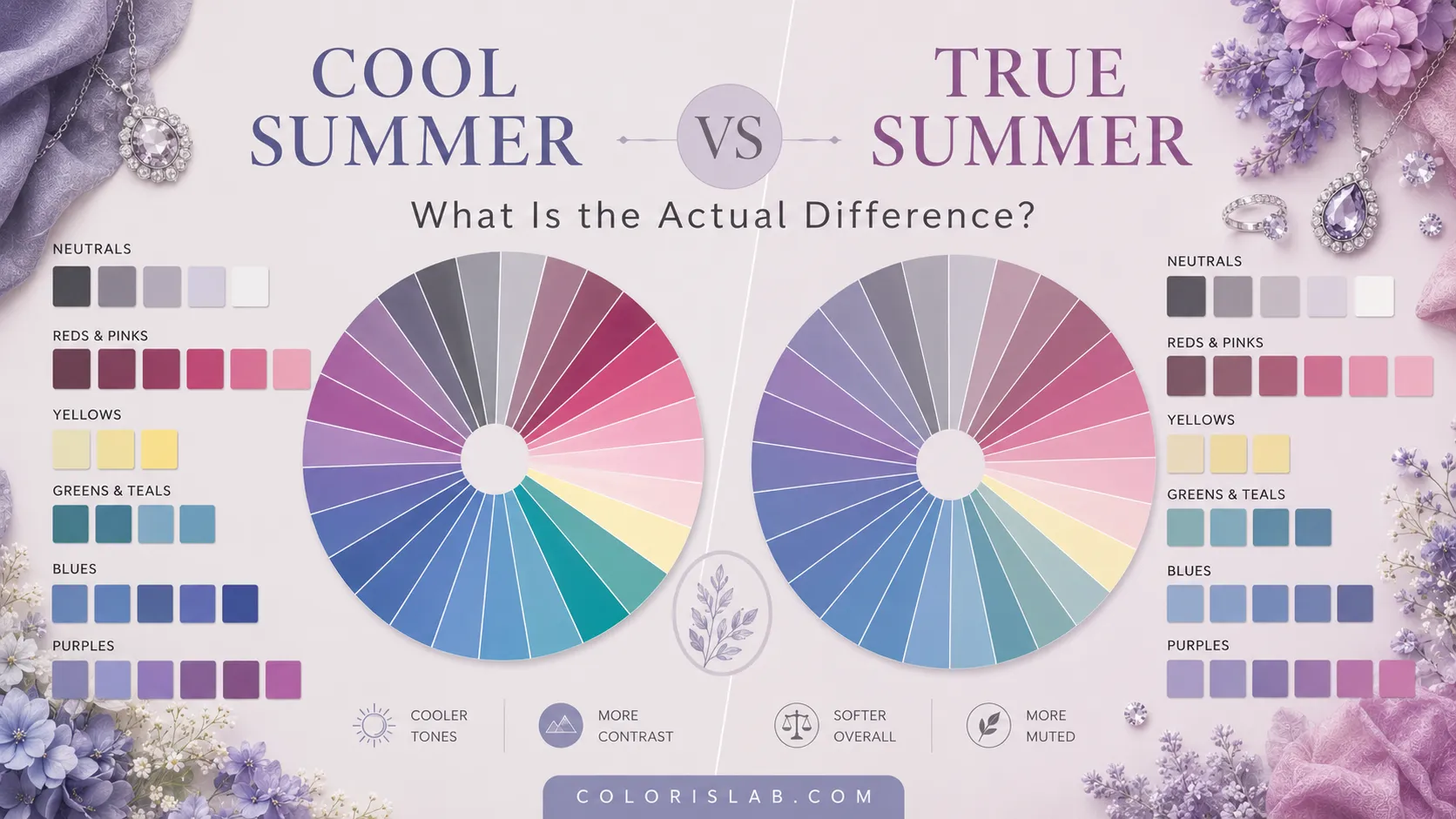
One of the biggest sources of confusion in modern color analysis is the difference between Cool Summer and True Summer. Some systems use these names interchangeably. Others separate them into two completely different subseasons. That is why so many people end up confused when they try to compare analyses online.
In the 12-season system, Cool Summer and True Summer usually refer to the exact same season: the coolest point of the Summer family. But in the 16-season system, these are separated into two distinct palettes with different priorities, different value ranges, and different reactions to color.
This article follows the 16-season approach. If you have ever felt stuck between Summer categories, especially between Light Summer, Cool Summer and True Summer, this guide will help you understand the difference properly.
The Core Difference
Both Cool Summer and True Summer belong to the Summer family. Both are cool-toned. Both are soft rather than vivid. Both look overwhelmed by warm Autumn earthiness and sharp Winter contrast. But they are not identical.
The easiest way to understand the distinction:
Cool Summer
Defined by coolness first. Sits closer to Winter. Carries a cleaner, colder, more refined type of coolness.
True Summer
Defined by balance first. Sits at the absolute center of Summer. Carries a softer, more blended, more traditionally Summery appearance.
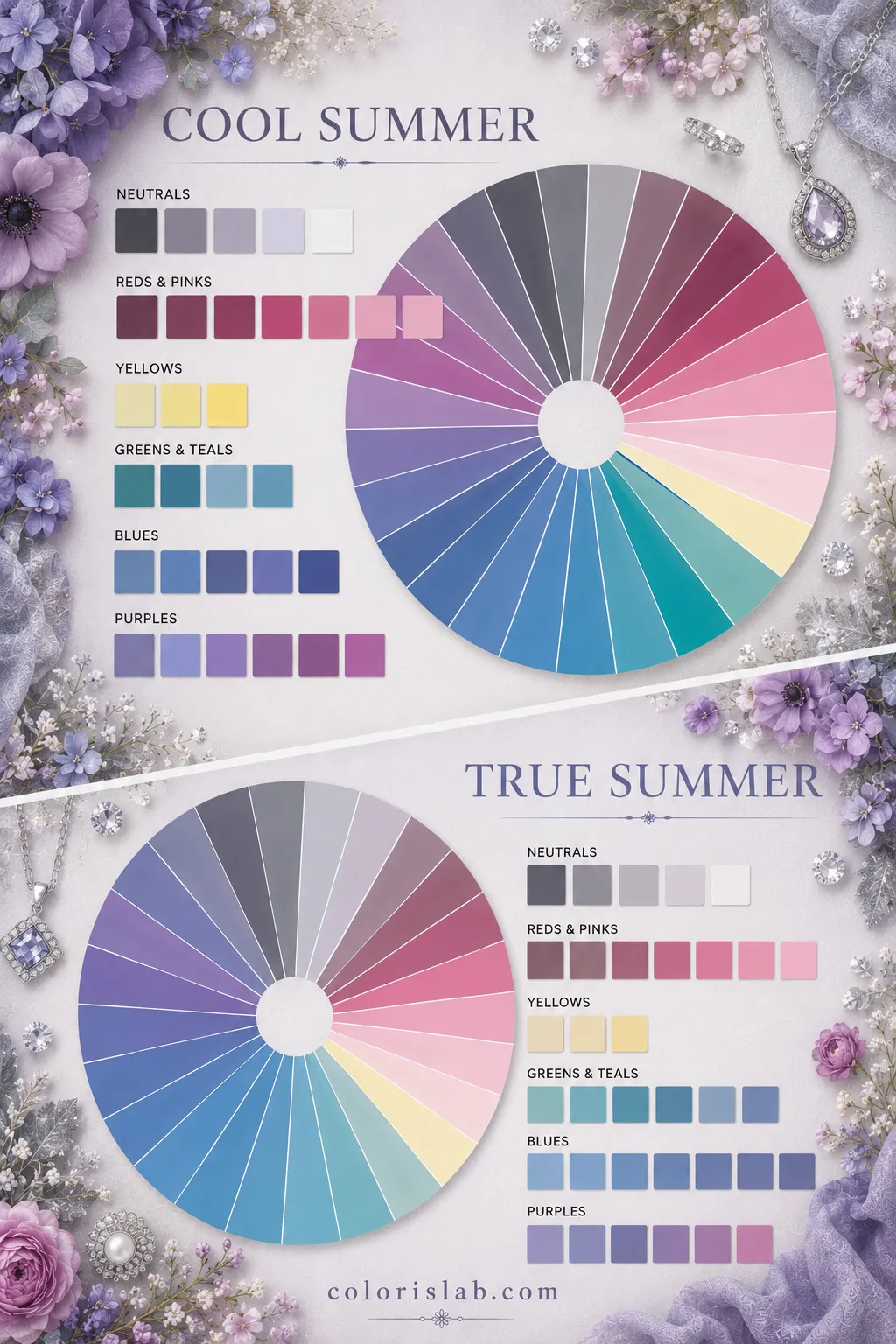
People often assume these two seasons look almost identical. In reality, they react very differently once you start testing saturation, contrast and depth properly.
Cool Summer: The Coolest Summer
Cool Summer is the coolest point inside the Summer family. In the 16-season system, it acts as a bridge between Summer and Cool Winter. That does not mean Cool Summer is dramatic like Winter. The palette is still soft overall. But compared to True Summer, the colors are noticeably clearer, colder and slightly sharper.
The most important thing about Cool Summer is that the coolness is unmistakable. This is not the neutral-cool softness of Light Summer. This is not the smoky neutrality of Soft Summer. Cool Summer reads cool immediately. The palette contains more icy influence, more blue-grey influence and more crispness compared to other Summers.
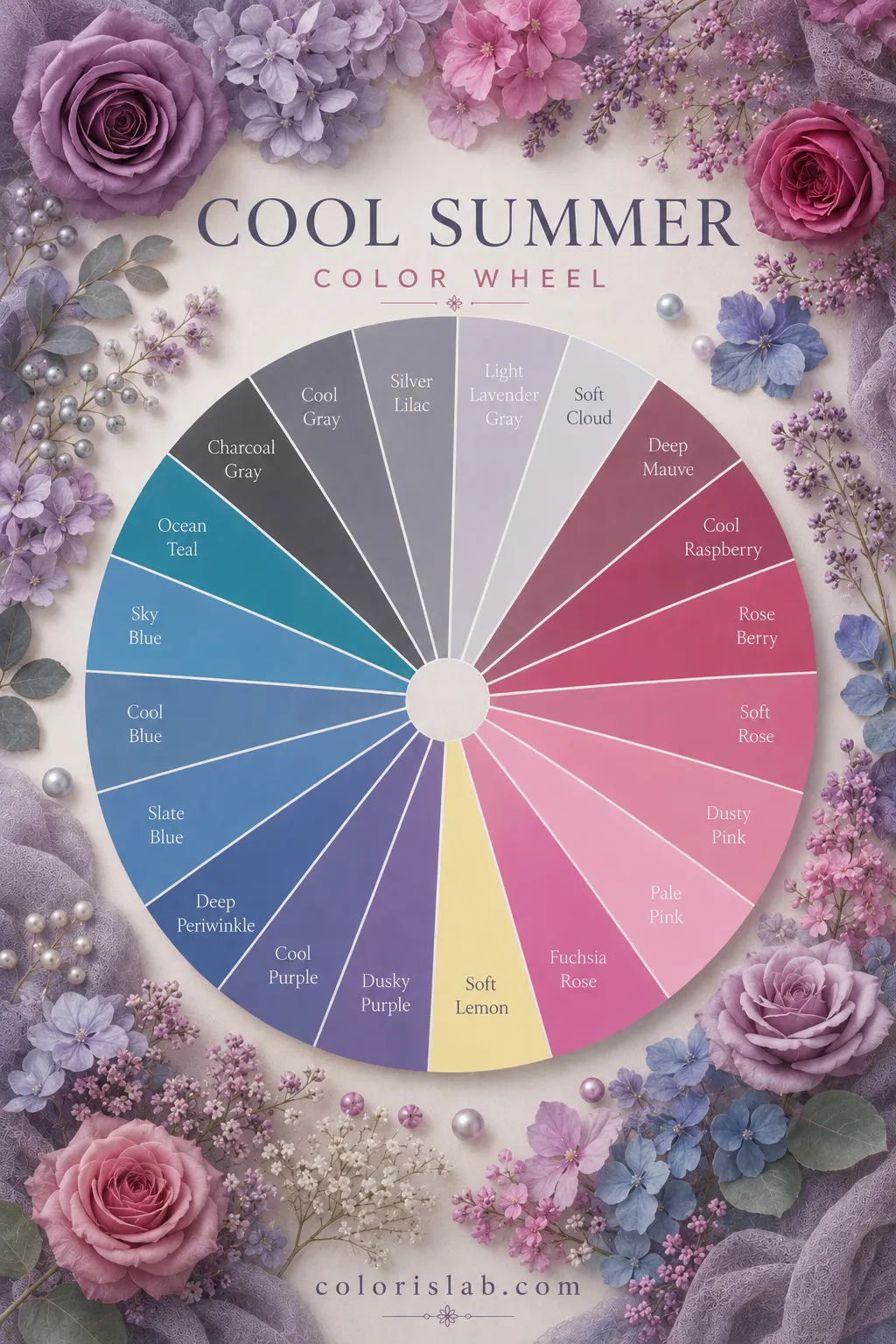
Typical Cool Summer colors
The overall effect is elegant, polished and refined. A Cool Summer person often looks naturally sophisticated even without makeup or styling because the coloring itself carries a certain cool clarity.
True Summer: The Pure Summer
True Summer sits directly at the center of the Summer family. Unlike Cool Summer, it does not lean toward Winter. Unlike Light Summer, it does not lean toward Spring. Unlike Soft Summer, it does not lean toward Autumn. It is Summer in its purest and most balanced form.
True Summer coolness feels gentler. More blended. More watercolor-like. Cool Summer feels cleaner and colder. True Summer colors often contain a slight mistiness that Cool Summer does not.
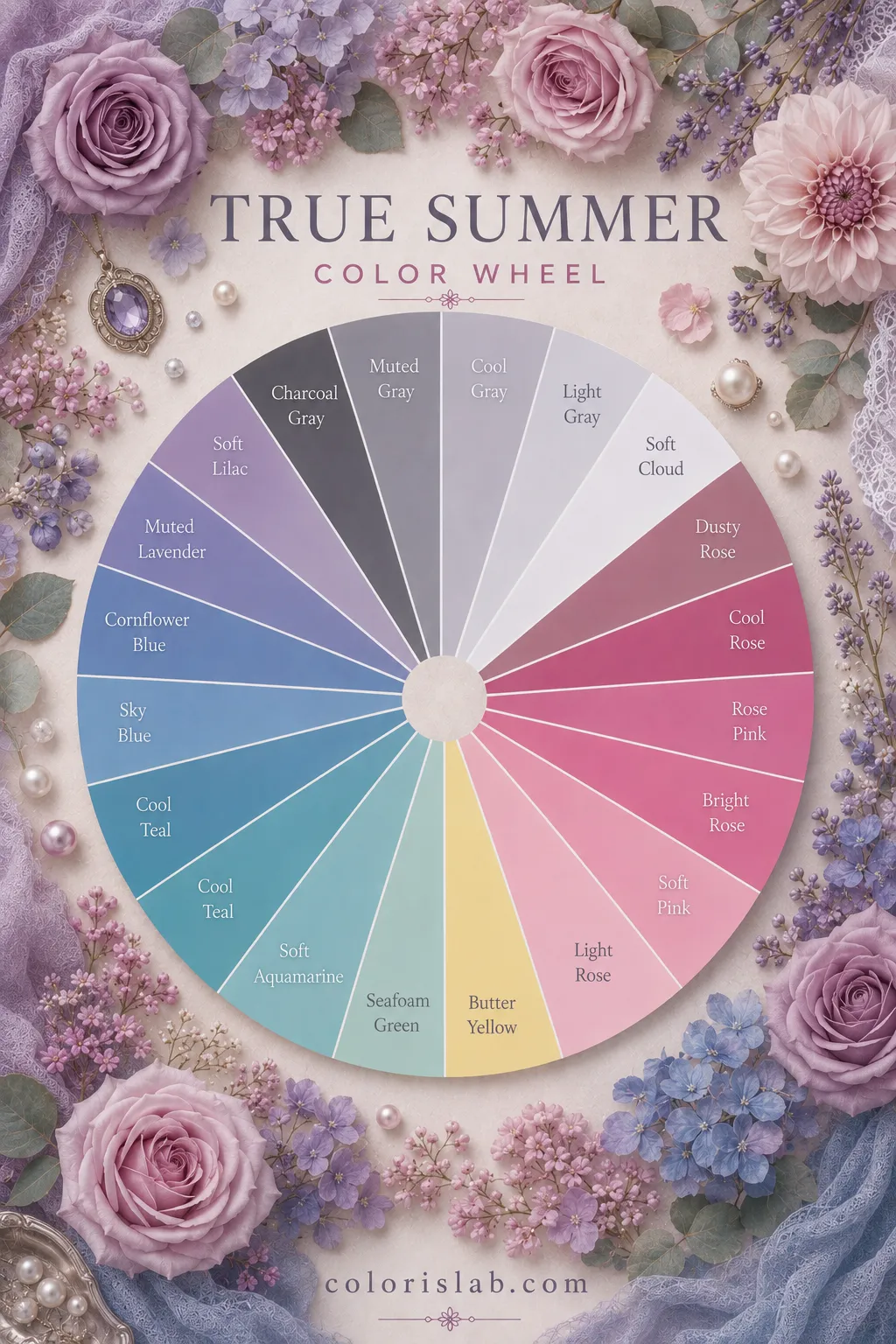
Typical True Summer colors
The overall effect is calm, romantic, delicate and harmonious. If Cool Summer looks elegant and polished, True Summer looks serene and naturally balanced.
The Biggest Mistake People Make
One of the most common mistakes in online color analysis is assuming every cool muted person automatically belongs to True Summer. In reality, many people typed as True Summer are actually Cool Summer, Light Summer, Soft Summer or even Cool Winter.
The confusion happens because people focus only on undertone. But undertone alone is not enough. Professional draping always requires analyzing undertone, value, contrast, chroma and color reaction together.
Two people can both be cool-toned and muted while still reacting completely differently to the same shades. That is why simply looking cool does not automatically make someone True Summer.
Cool Summer vs True Summer in Draping
The easiest way to separate these two seasons is through direct comparison draping. The difference becomes extremely obvious when testing medium-depth colors.
Test the difference on your own photo
Drape Cool Summer and True Summer palettes side by side and see exactly how your skin responds to each one.
Open Virtual Draping Studio →The Palette Difference
Many people expect the palettes to be dramatically different. They are not. The difference is more about temperature intensity and clarity.
Cool Summer palette
- Cooler
- Cleaner
- Slightly icier
- Slightly sharper
- Closer to Winter
True Summer palette
- Softer
- More blended
- More watercolor-like
- Slightly more muted
- Pure Summer balance
Cool Summer resembles a cool cloudy morning. True Summer resembles soft rain and mist. Neither is bright. Neither is warm. But one is visibly colder.
Facial Features and Overall Impression

Cool Summer often has
- More noticeable eye clarity
- Slightly stronger definition
- Cool ash contrast
- Sharper coolness in hair or eyes
- A more refined appearance
True Summer often has
- Very blended coloring
- Gentle transitions
- Low visual sharpness
- A softer facial impression
- A watercolor effect overall
Makeup Differences
This is one of the easiest ways to spot the distinction in real life.
When a True Summer wears makeup that belongs to Cool Summer, the face can suddenly look slightly heavy or overdefined. When a Cool Summer wears very soft True Summer makeup, the features can start looking flat or blurry.
Black and Jewelry
Neither season truly belongs in black the way Winter does. But Cool Summer usually tolerates black better because it sits closer to Winter and has slightly more cool definition. True Summer often looks visibly overpowered by strong black. On a True Summer, black can feel harsh, heavy and too contrast-heavy. This is one of the easiest real-life tests between the two.
Cool Summer jewelry
- Bright silver
- Platinum
- Icy silver finishes
- Cool polished metals
True Summer jewelry
- Soft silver
- Brushed silver
- Rose silver
- Muted white gold
Highly reflective icy metals often start overpowering True Summer softness. Both seasons generally suit silver, but the quality and finish differ significantly.
Final Comparison
Cool Summer creates refined cool sophistication. True Summer creates soft harmonious serenity. That difference may sound subtle in theory, but in draping it becomes immediately visible.
Still unsure which Summer you are?
Our AI tool analyzes your photo for undertone, contrast and chroma and gives you a starting point before going deeper into Summer subseasons.
Try the Free AI Tool →Frequently Asked Questions
What is the difference between Cool Summer and True Summer? ↓
Which Summer season is the coolest? ↓
Can True Summer wear black? ↓
Can Cool Summer wear brighter colors? ↓
How do I know if I am Cool Summer or True Summer? ↓
Is True Summer softer than Cool Summer? ↓
Why do some systems combine Cool Summer and True Summer? ↓
Why do people confuse Cool Summer with Cool Winter? ↓
Can Cool Summers have dark hair? ↓
What metals look best on Cool Summer and True Summer? ↓
ColorisLab Team
Color Analysis ExpertsWe're a team of color analysis enthusiasts dedicated to helping people discover their best colors and build confidence through personalized color advice.